Showing posts with label orchid. Show all posts

Monday, 18 July 2016

Quick New Forest trip

My housemates have been busy obsessing over Pokemon Go, but I've resisted the temptation to download it myself and instead decided to pop down to the New Forest on Monday morning to 'catch' a couple of real-life organisms instead: Bog Orchid and Silver-studded Blue. Having not tried for them before, the former was a new orchid for me and it was several years since I'd seen the latter.

First stop was a small, boggy slack not too far from the A31. Among the many sundews (Drosera rotundifolia?) and other interesting plants I eventually got my eye in and started to pick out my first Bog Orchids. I'd heard that these things are notoriously difficult to see as they tend to be absolutely tiny but there were several well-grown and robust specimens that positively towered at around 15cm! The closer I looked, the more these dainty orchids became apparent - I counted at least 30 without too much effort. Photographing such a tiny plant among dense, grassy vegetation wasn't such an easy matter, and you have to be extremely careful here to avoid trampling the orchids and other plants. Thanks, as ever, to Sean Cole for his handy gen.

Bog Orchids are tiny and can be extremely difficult to see among the vegetation

An impressively sized and photogenic specimen - just a shame it was a little over

Another sizeable specimen and in better condition

Close-up of the above individual

There were several robust specimens 'towering' at over 10cm tall, but this was a more typical spike (with 20 pence piece for size comparison)


I then headed over to Ocknell Plain and spent about half an hour chasing the hundreds of Silver-studded Blues around, trying for nice photos. A hard species to do justice to once they've warmed up!

The only individual I found with its wings still closed on what was a very warm morning 

 A delightfully fresh male sunning itself

On my way back to London I called in at Alice Holt Forest, near Farnham, and spent a little over an hour walking up and down the ride at Straits Inclosure. It was a gloriously hot and sunny morning and therefore flummoxing to learn from all the butterfly-ers returning along the track that no-one had seen any Purple Emperors! Plenty of butterflies were on the wing, though, including several Marbled Whites and some beautiful Silver-washed Fritillaries. I hung around at the second observation tower for a while and was rewarded with a flyover Purple Emperor at 11:18 - it did a couple of loops, attacked a Brown Hawker and then disappeared in to the treetops. Despite my best efforts to lure it down, I didn't see it again - or any others for that matter.

Monday, 20 June 2016

Chlorantha Bee Orchids

I've been wanting to see the beautiful white form of Bee Orchid - chlorantha - for some time, and they really didn't disappoint. At least seven seen, along with three 'normal' Bees, at a site to the south of Norwich at the weekend, the chlorantha including a particularly robust specimen which towered well above all others in the vicinity.


And, just for the sake of comparison here's a regular, run-of-the-mill Bee from the North Norfolk coast a little later in the day.


Thursday, 16 June 2016

Calypso Orchids at Oulanka NP

Calypso bulbosa is arguably the most stunning of all Europe's orchids. Known more widely as the Fairy Slipper or Calypso Orchid, the flowering plant is a perfect design of nature. Exhibiting one or two rounded green leaves at the base a deep red stem that reaches heights of around 15cm, its appearance is one of uncluttered simplicity. This ensures that the plant's crowning glory, its sole pinkish-purple flower, enjoys undivided attention.

It's impossible not to admire this species in full fettle. It is a genuine work of art - delicate, intricate and exotic, the amazing flower of Calypso bulbosa looks like it belongs in the tropics rather than the taiga - yet it thrives in Finland's boreal forests.

At 66 degrees north, among the decaying pine needles that litter the forest floor of Oulanka National Park, excellent numbers of flowering Calypso Orchids can be found in late May and June. We were fortunate to find several tens of this spectacular species about a kilometre east of the visitor centre, some right by the main path - many thanks to the help and expertise of Sean Cole, who was back home in the UK at the time.. Here are a few photos.


Tuesday, 7 June 2016

Late Spider Orchids

All European orchids have a charm to them but it is the genus Ophrys - the insect imitators - which are my favourites. These, arguably the most characterful of all Palearctic taxa, tend to be quite small and at first can appear inconspicuous. Look closer and they are anything but - the flowers are invariably stunning, their beauty epitomised by a spectacularly patterned lip which immediately draws focus. Indeed it is not just the botanist that finds them so alluring - so well-designed are the flowers that they readily fool amorous male insects in to mating with them, thus pollinating them.

Four Ophrys species occur in Britain. Bee Orchid is by far and away the most widespread and recognisable while Early Spider can be found in colonies numbering in to the thousands along the south coast in April and May. The third species, the diminutive and elegant Fly Orchid (my favourite British orchid), is also quite widespread but never particularly common. That leaves a final, much scarcer representative - Late Spider Orchid. Occurring at just a handful of locations in Kent, Late Spider is the trickiest member of its genus to see in Britain - or at least as tricky as twitching stationary flowers can be. Perhaps I should say it's the one that requires the most effort ...

For various reasons I have failed to make said effort to see Late Spider Orchid in either of the previous couple of years. I was determined to put the record straight in 2016 and so set an alarm for 04:00 on Sunday morning. Somewhat miraculously I resisted the urge to ignore it and was soon out of bed and on to the M25, heading for the far south-east as the sun began to rise.

The first colony of Late Spiders I visited were easily found thanks to the myriad of protective cages that betrayed their presence. The majority weren't yet flowering and many were stunted and unimpressive; just one or two plants looked good and so photo opportunities were a bit limited. James Lowen had informed me that this is a good site for Black-veined Moth but I couldn't see any in a reasonably brief search - perhaps it's still a tiny bit early in the year for them? Either that or I was still half asleep.


With the Late Spiders failing to impress I headed over to another site, nearer to Folkestone. Here I found a much better range of flowering specimens and, although the 20 or so plants meant that photo opportunities were always going to be a little restricted, I came away with a more pleasing series of images. I was struck by the amazing variation in lip shape, size and pattern among individual plants - the British colonies are apparently notorious for this. Also here were a few fairly puny Man Orchids and a handful of Common Spotted just beginning to flower.


I still haven't worked out what conditions I find best for photographing orchids. I quite like the early morning sunshine, which gives the subject a nice glow, but bright sunshine quickly becomes too harsh at this time of year and I tend to prefer neutral light for photography anyway. The above three images were taken during a brief spell of cloudier conditions at the second site while the below image was taken in sunshine.


Offering more or less wall-to-wall blue skies, Sunday was fantastic morning to be out on the Kent Downs. Late Spider was my first new orchid of 2016 - I have a few more targets to mop up in the coming weeks, so be prepared for one or two more flowery posts.

Tuesday, 9 June 2015

Homefield, 6 June

On Saturday morning I visited Homefield Wood near Marlow. Military Orchids were just past their peak with some plants browning, although those in the shadier areas still looked pretty good. I've visited this site at least once for the past three years and my impression was that there were fewer plants this year, and most were smaller in size than I remember them being. Perhaps I was looking through rose-tinted spectacles in the past.

 Military Orchid

The most impressive specimen

Common Spotted were beginning to flower while a nice carpet of Common Twayblade were approaching their peak.

Common Twayblade

A few Greater Butterfly Orchids were looking spectacular, as they always do.

Greater Butterfly Orchid close-up

I also found this dopey Slow-worm under a tin, which was evidently still too cold to move and simply sat there looking a bit pissed off with life.

Slow-worm - always a treat

I then moved round to nearby Moorend Common, where the southern meadow was awash with Southern Marsh, Common Spotted and assorted hybrids, all beginning to flower and probably still a fortnight off looking their best. The northern meadow is supposed to contain hundreds of flowering Heath Spotted Orchids - a potential tick for me - so I headed there next. Plenty of Heath Spotted, yes, but none yet in flower ...

Heath Spotted Orchid - still a way off flowering

Wednesday, 3 June 2015

A day in North West England

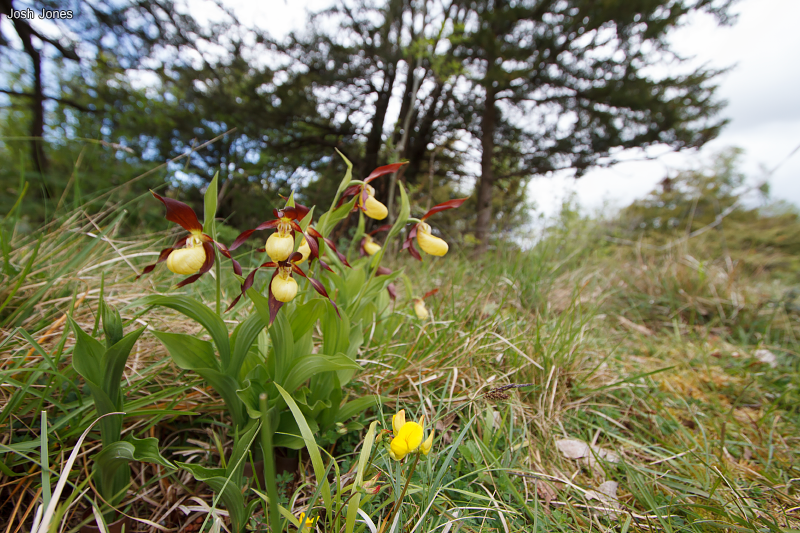
James Lowen and I had intended to visit Gait Barrows near Silverdale, Lancashire, last summer in order to see the reintroduced Lady's Slipper Orchids that can be found there. For many species - flowers, but also insects and others - summer 2014 was a particularly 'early' season following a very warm spring and, by the time we'd got round to thinking about going, we'd missed our chance with the LSO (although it's a great reserve for Dark Red Helleborine, High Brown Fritillary etc later on).

As a result, we'd had a late May trip pencilled in since the beginning of the year. This year has been a total contrast to the previous; a particularly cool and wet May has dictated a fairly late spring this year and as such we were a little hesitant on whether our quarry would be in peak condition ...

With a visit north-west planned, I'd seized the opportunity to hunt down gen for two other species that do not occur further south and east - Coralroot Orchid and Lesser Twayblade. Having spoken to Sean Cole and gleaned some valuable contacts and information, the news was positive - both were flowering and a plan was quickly formed.

I decided to drive through the night so that I was at Cliburn Moss for first thing. After an unsuccessful hour poking around the reserve's mossy floor and being eaten alive by some of the most persistent midges that I've ever come across, reserve warden Colin Auld became my proverbial knight in shining armour, pointing out several Lesser Twayblades almost immediately upon his arrival. I'd been searching just a few metres away and not seen one! The twayblades became an instant favourite - they're absolutely tiny yet unquestionably stunning, the rich pinkish-red stem and flowers blending in perfectly with their surroundings. As I'd spent so long searching and knowing that I had to be at Sandscale Moss for 10 am, my photo opportunities were limited and I left a little unsatisfied with my efforts.


Lesser Twayblade - not the easiest species to spot!

Next stop was Sandscale, where wardens Neil and Jamie showed us to the Coralroots. After a number of poor to average years the number of flowering plants has exploded this May, with over 1,700 counted. We were shown a good few hundred in slack 28 and then I was fortunate enough to join their ongoing survey, finding plenty more in other parts of the reserve. Again, it's an orchid that's remarkably small and very easily missed (trampled), so you really have to be careful where you're treading.

 Coralroot Orchids are very easy to tread on - I'm speaking hypothetically, of course!

That's more like it ...

James was hoping to meet me at Sandscale early afternoon but appalling traffic had curtailed his efforts; I therefore met up with him at Gait Barrows where we half admired, half baulked at a number of Lady's Slipper Orchids in fine fettle. When you see them, it's certainly hard to accept that they're very much a British species as opposed to an out-of-place exotic, which they certainly resemble.


From the sublime to the ridiculous - Lady's Slipper Orchids

Very smart, but the presence of slug pellets and various copper tubes didn't exactly make for an authentic experience! I was as happy with my first Northern Marsh-orchids, just starting to open up ...


Sunday, 31 May 2015

May Orchids

A first outing for me this season last weekend (23 & 24 May), Sword-leaved was a tick while the only Lady I had seen previously was a single plant at Hartslock that was some way past its best. Seeing thousands of both species was pretty eye-opening!

Bigger, better versions on my Flickr pages.

Lady Orchid, Kent

Monkey Orchid, Kent

Sword-leaved Helleborine, Hampshire

Fly Orchid, Hampshire


Burnt-tip Orchid, Hampshire

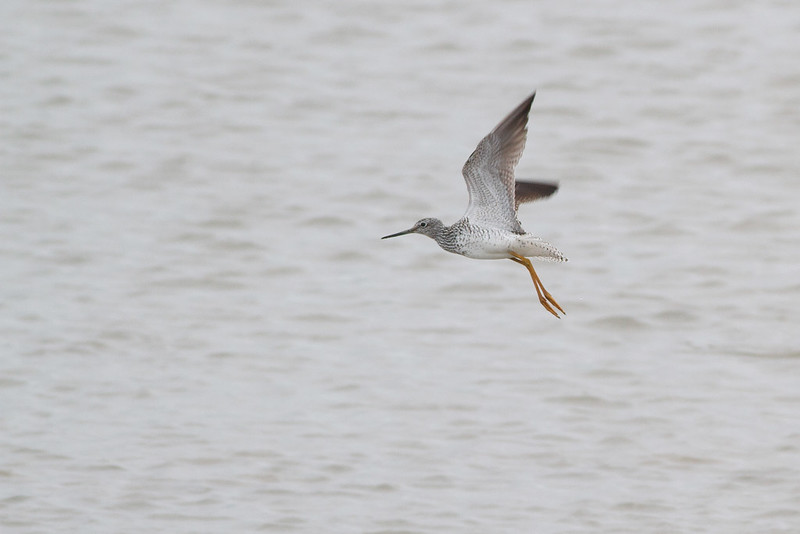
I also managed to jam in on the Greater Yellowlegs at Titchfield Haven on Sunday:

Greater Yellowlegs

Wednesday, 10 July 2013

They did warn me...


I've been told by a number of people that getting in to orchids can be a dangerous game. As Mr Lowen said to me once, "you think large white-headed gulls are hard? Wait 'til you get in to dacts!". I laughed it off. I'd seen some strange looking creatures down at my dad's old place in Kenfig, and thought I was well prepared for problematic Dactylorhiza-types. Then, while at Holt Country Park in Norfolk over the weekend, this 'thing' appeared in front of me and left me flummoxed:


The plant was in a marshy area at the bottom of the country park's heath area, among many hundreds of Common Spotted Orchids. At a first glance I presumed it to be a Fragrant Orchid due to the lack of spots on the leaves and flowers but, to me, the size (huge) and shape of flowers is not right. The shape and structure is kind of reminiscent of Common Spotted Orchid, but the obvious lack of spots (and the overall flower structure) are not quite there.

So, is it a Fragrant x Common Spotted Orchid? I'd be more than interested in others' thoughts!

Saturday, 6 July 2013

Last week at Collard Hill

It's been a breathless couple of weeks, and I haven't yet had chance to share a few photos from Collared Hill on 28th June. Large Blue proved really difficult and it was only within the last five minutes of our 5-hour visit that we finally scored.


Also seen were a few Wasp Orchid spikes along with a more typical Bee Orchid.