Grey Hypocolius, Sulaibhikat, 13 January 2018
Showing posts with label january. Show all posts
Sunday, 18 February 2018
A weekend in Kuwait
I will try to produce a more lengthy photo-blog from my January trip to Kuwait with Sam Viles in due course, but in the meantime here is an article I wrote on the few days for the BirdGuides website: www.birdguides.com/articles/a-weekend-in-kuwait
Sunday, 7 January 2018
Good birding at Dungeness
Had a nice day at Dungeness with Rich, Dante and Niall. En route we stopped at Crayford, where a Mediterranean Gull was seen among the good numbers of congregated birds at Jolly Farmers.
Then it was down to a rather breezy Dungeness fishing boats, where the regular Caspian Gull was still performing well - this bird is easily the most photographed Casp in Britain this winter and has probably been seen by hundreds of birders since it turned up in September. Still, it's a very elegant individual and always worth photographing.
Moving down to The Patch revealed thousands of gulls feeding around the outflow, although the light was challenging to say the least. Thankfully the regular juvenile Glaucous Gull performed well overhead, although the 3cy Iceland Gull was a little more difficult to pick out among the throng. An adult hybrid Black-headed x Mediterranean Gull was the first I've seen of this cross in Britain (I'd previously seen a couple in Ireland, both on the same weekend trip).
The RSPB reserve was somewhat devoid of gulls, yet the presence of a drake and redhead Smew, a female Ruddy Duck (my first in the UK for some years) and a bunch of Goosander were pleasant.
After a quick trip to Lade for some stodge from the local store it was back to the fishing boats, where Mick, Richard et al were photographing a very smart 3cy Caspian Gull on arrival. No hint of a p10 mirror, it was otherwise a very contrasted and crisp bird that was easily picked out from among the Herrings with the naked eye. It was blowing an absolute gale from the ENE, which made photography a real challenge given the position of the sun.
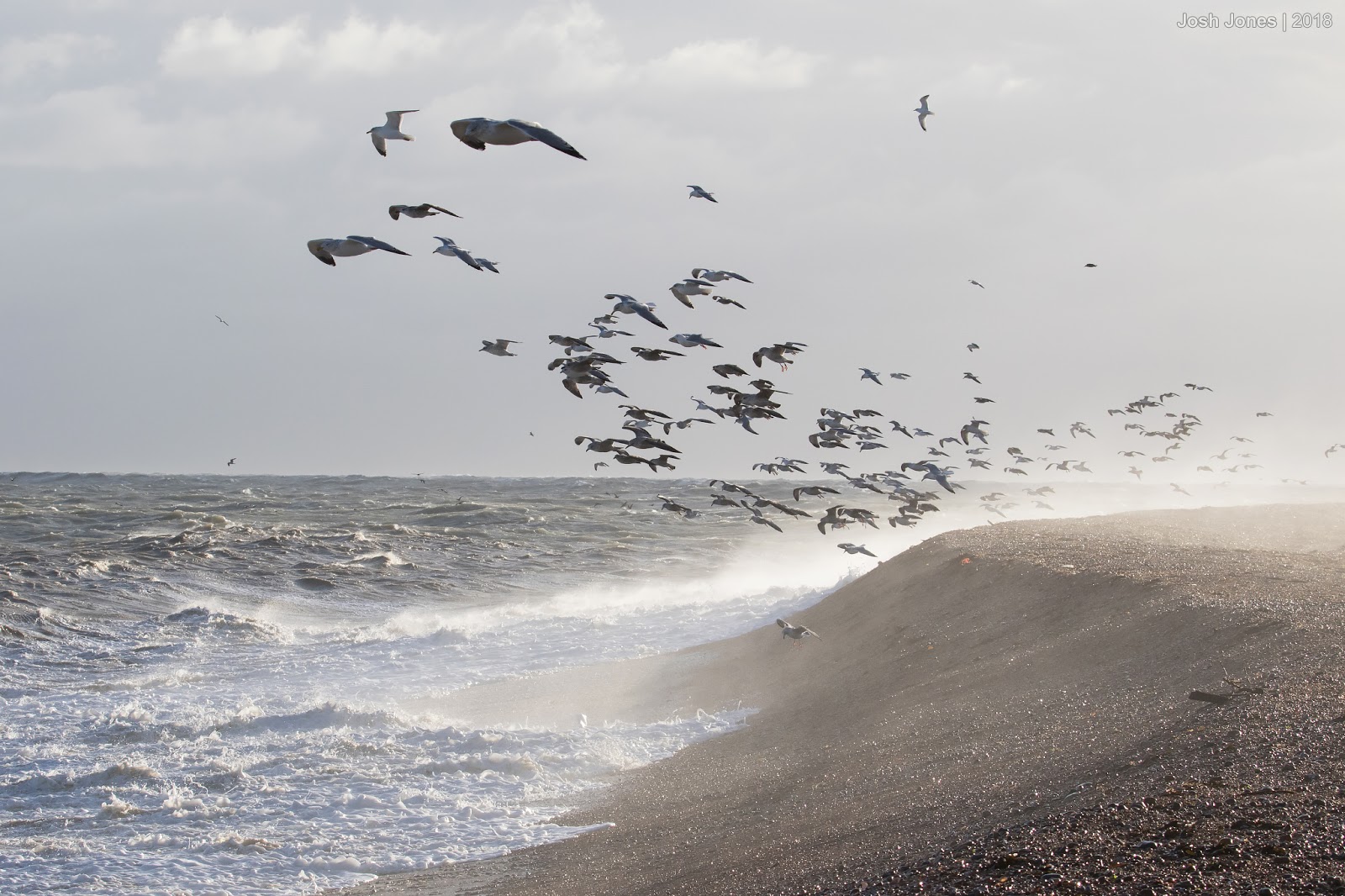
With nothing else on show, I took some photographs of the gulls floating in the gale. There was evidently quite a lot of food washing up on the beach as the gulls were actively feeding ... and ignoring the less appetising loaves we were chucking out!
Then it was down to a rather breezy Dungeness fishing boats, where the regular Caspian Gull was still performing well - this bird is easily the most photographed Casp in Britain this winter and has probably been seen by hundreds of birders since it turned up in September. Still, it's a very elegant individual and always worth photographing.
2cy Caspian Gull, Dungeness, 7 January 2018
2cy Glaucous Gull, Dungeness, 7 January 2018
After a quick trip to Lade for some stodge from the local store it was back to the fishing boats, where Mick, Richard et al were photographing a very smart 3cy Caspian Gull on arrival. No hint of a p10 mirror, it was otherwise a very contrasted and crisp bird that was easily picked out from among the Herrings with the naked eye. It was blowing an absolute gale from the ENE, which made photography a real challenge given the position of the sun.
3cy Caspian Gull, Dungeness, 7 January 2018
Saturday, 6 January 2018
A confiding Hawfinch
Thanks to Lee Fuller and Ian Wells for their help in photographing this beautiful male at Romsey, Hampshire.
Monday, 23 January 2017
Mid-January patch efforts
It remains cold across much of Britain, particularly the south-east, and such conditions usually mean winter birding is at its most productive in London.
It was grey and misty when I headed out late morning. An impressive flock of Tufted Ducks has formed on the Chiswick-Barnes stretch of the Thames, although the amassed group of 101 failed to throw up anything more interesting.
The wetlands centre was pretty decent - great views of two Bitterns including the below individual, which bizarrely stood more or less motionless on the frozen ice in front of Headley Hide for 10 minutes, before slinking off back in to the reeds. A Jack Snipe was flushed by crows just before Wildside Hide, flying around my head a few times before dropping back in to the reeds. I glimpsed a Water Pipit on the grazing marsh and heard the Bearded Tit pinging in the reeds on one occasion. Nine Pintail included six drakes but wildfowl numbers seemed slightly down on my visit the previous week, presumably because of the freeze. A flock of Fieldfares moved through and both Cetti's Warbler and Water Rail were new for the year for me. About 40 Herring, 10 Lesser Black-backed and a few Great Black-backed made up the gull flock.
A check of the Hammersmith-Fulham stretch of the River Thames revealed my first Yellow-legged Gull of the year, a rather smart adult, among just 30 or so Herring Gulls. A Little Egret was at Chiswick Eyot mid-afternoon, another new bird for the year for me.
It was grey and misty when I headed out late morning. An impressive flock of Tufted Ducks has formed on the Chiswick-Barnes stretch of the Thames, although the amassed group of 101 failed to throw up anything more interesting.
The wetlands centre was pretty decent - great views of two Bitterns including the below individual, which bizarrely stood more or less motionless on the frozen ice in front of Headley Hide for 10 minutes, before slinking off back in to the reeds. A Jack Snipe was flushed by crows just before Wildside Hide, flying around my head a few times before dropping back in to the reeds. I glimpsed a Water Pipit on the grazing marsh and heard the Bearded Tit pinging in the reeds on one occasion. Nine Pintail included six drakes but wildfowl numbers seemed slightly down on my visit the previous week, presumably because of the freeze. A flock of Fieldfares moved through and both Cetti's Warbler and Water Rail were new for the year for me. About 40 Herring, 10 Lesser Black-backed and a few Great Black-backed made up the gull flock.
You ain't fooling no-one, pal ...
That's more like it.
Adult Yellow-legged Gull, Fulham, 23 January 2017
Sunday, 22 January 2017
Pine Bunting!
After the autumn's record influx, it seemed inevitable that the odd Pine Bunting would be unearthed in the British countryside this winter. By the end of 2016 that inevitability had not yet materialised, but it was on New Year's Day that a female was found at Venus Pool, Shropshire. Unfortunately it proved extremely elusive and was seen well only the following day; it was reported on subsequent dates but always briefly and many left the site having dipped.
Pine Bunting, along with Aquatic Warbler, has sat at the top of my 'most wanted' list of birds to see in Britain for years now. I dipped the Choseley bird twice back in the day and, unable to get a lift to Worcestershire in 2005, it's been a long wait for another. I've always found it an interesting species - females are subtle (thus providing a genuine identification challenge), there's always the hybrid issue to consider and overcome, and males in particular are really dapper birds. It's also one of those species that you feel anyone has a fighting chance of finding given their penchant for turning up at otherwise uninspiring inland sites. The problem these days, as much as any other, appears to be finding flocks of their fast-declining western counterpart, Yellowhammer, to search through. It's quite depressing how depleted this species is in the British countryside even compared to when I started actively birding in the early to mid-2000s, when its populations were already severely reduced from historical levels.
New Pine Buntings have been popping up all over Western Europe on what seems like a daily basis this January, and another in Britain never seemed far away. Step forward Chris Gomersall, who did a fine job by pulling out a stunning male from among a big Yellowhammer flock at Dunnington, just east of York, on Friday. The bird showed a few times over the Saturday and so I decided to head for the site early on Sunday in order to try my luck. The main problem was that I didn't have my telescope, and this was most definitely a 'scope job. On arrival a big crowd of birders were looking in to a rough field at several hundred metres' range - not something my 8x bins were ever going to deal with!
After a nice catch-up with Andy and Vicky I decided to make use of myself and head off to explore the surrounding fields, in the hope that I might stumble across birds that were remotely close enough to check with binoculars. The sheep field where the bird had been seen on Saturday seemed a good place to start. Quite amazingly, no one else was looking and so I carefully walked the field edge, sifting through the various species feeding in the field or sitting in the hedgerows - there were plenty of Yellowhammers, a few Reed Buntings, various finches and lots of winter thrushes.
The whole place seemed very 'birdy' and undisturbed, so I decided to sit down by the fence. This caused the sheep to spook and consequently flushed everything up in to the trees, but soon enough birds started dropping back down. I sat there for about 10 minutes before, suddenly, an unmistakable brown-and-white head pattern appeared among a small group of Yellowhammers at 50 metres' range. No doubt that it was the male Pine Bunting, and in fantastic light too! The bird was extremely wary and mobile - even the excited reach for my camera caused the flock to pop back up in to the trees - but soon it came back down. I made a few calls to friends in the main crowd and awaited their arrival.
Uncropped (top) to ultra-cropped versions of the same shot ... the Dunnington Pine Bunting
I had a few brief views over a five-minute period, with the bird landing no more than 20 metres away at one point. Unfortunately it sat still, facing away, for about five seconds before bolting off again. If only it'd fed there for a little longer and turned to profile..!
The number arriving birders was never going to help - the increased movement and commotion clearly wasn't to the feeding flock's taste and they quickly moved away down the hedgerow, back west towards the original field. I always find bunting flocks can be very nervy and thus the utmost care needs to be applied when trying to watch them, even when on your own. The birds were very edgy with just me there, so it's no real surprise that they moved off when more started to arrive. A shame, but I think the bird was seen on back over in the other field on a couple of occasions shortly afterwards. Clearly this is a challenging bird to see but the corner of the field at 53.9679, -0.9678 seems to be a good area for feeding birds, and is well worth focusing on if visiting in the coming days. The Yellowhammers (and Pine Bunting) spent most of their time feeding around the fallen tree about 30m along the hedgerow running WSW back towards the farmhouse.
Given the autumn's arrival and the numbers just over the Channel in e.g. the Netherlands, there must be so many out there waiting to be found in unsuspecting patches of the British countryside. Hopefully a few more individuals of this brilliant species might be found before spring.
Sunday, 8 January 2017
Showy Caspian at Hammersmith Bridge
I've been hoping for one of these on my adopted 'patch' since I started looking at the gulls properly last summer. Rich, Jamie and Dante have been gripping me off with their shots of ever-present Caspian Gulls in East London but I've kept the faith with the stretch of the River Thames between Chiswick and Fulham. Finally, it's paying off. After Friday's brief third-winter, which was not photogenic in any way, I was suitably thrilled to pop my head over the river wall at Hammersmith and see this first-winter Casp gazing back at me.
I was initially a bit concerned about the mucky underwing and structure but Rich quickly allayed my fears and, having watched and photographed it for an hour or so, I'm happy it's more than fine for pure cachinnans. The first of many happy encounters here, I hope!
And a slightly larger photo (click to enlarge) ...
Subscribe to:
Posts (Atom)