Showing posts with label red. Show all posts

Wednesday, 7 March 2018

Red-throated Diver etc

An adult Red-throated Diver turned up in Peterborough during the cold weather last week, and I paid it a couple of visits. On my second visit, the bird spent its time exclusively floating motionless, closing its eyes, and I assumed it was a goner. It has since perked up and moved to Ferry Meadows, where it seems much healthier.


Red-throated Diver, Thorpe Meadows Rowing Lake, March 2018

Local birding has otherwise been reasonable enough, with a good passage of birds once the thaw set in, with species such as Pintail and Mediterranean Gull at BLGP and the returning adult Yellow-legged Gull at Deeping Lakes, which again seems paired with a Herring Gull.

 Raven, Baston & Langtoft Pits, 6 March

Adult Yellow-legged Gull, Deeping Lakes, 7 March

Monday, 13 February 2017

A familiar Yellow-legged Gull and hints of spring

It felt almost springlike out of the wind today, and fittingly I saw my first butterfly of the year - a Red Admiral hurriedly commuting between riverside gardens adjacent to Chiswick Eyot. Poor thing must've been chilly.

With cloudless skies and temperatures having recovered somewhat from the weekend, it felt like a decent day to be looking skyward and so it proved. A Common Buzzard headed south over London Wetland Centre at height at 11:49 and a little later, a Red Kite drifted low west over the Thames and then the Harrods Furniture Depository at 12:06. Both new species for the year, the latter the first I've seen here.

Common Buzzard high over the wetland centre ...

... and a somewhat lower Red Kite

Personal highlight of the morning was a striking 2cy Yellow-legged Gull. This bird, with its extremely distinctive aberrant bill pattern, was first seen by Rich Bonser by the O2 Arena on 17 August 2016 and then intermittently either there or at nearby Thames Barrier Park until 23 December (and again on 11 February per Dante Shepherd). See Rich's photos here. This is, to the best of my knowledge, the first time it's been seen away from East London.


I finished the day at Chiswick Pier, feeding a legion of Black-headed Gulls. They recognise me and my bike now - as soon as they see me pull up they come in and wait for me to get the bread out my bag. It's nice to see a lot of them are now acquiring their hoods. Another encouraging sign that the long, happy days of spring and summer aren't far away.


In addition to the gulls, this Egyptian Goose was grateful for my offerings.

Saturday, 2 April 2016

A few thoughts on the Israeli Red-billed Teal

In early March I spent a long weekend in Israel, where the primary target was the long-staying Bateleur (which we saw). A real bonus was hearing of the continued presence of the Red-billed Teal in the northern Arava, 're-found' by visiting Finns Seppo and Hannu and seen shortly afterwards by visiting Brits Chris Bell et al. As we were at the Arava junction of Routes 40 & 90 when Chris' SMS came through on 5th, we bolted straight up to Hazeva and saw the bird pretty well in the strong mid-afternoon light, though it was very wary and was mainly seen in flight.

Red-billed Teal, Hazeva, Israel, 5 March 2016

Long before the trip I'd been a fan of this bird being the real deal. Israel boasts the only previously accepted Western Palearctic record of the species (in June - July 1958) and of course has a strong track record with producing extremely rare sub-Saharan African vagrants. Barak Granit wrote an interesting article on the Israel Birding Portal website which coherently summarises where we are seemingly at regarding this latest bird. His conclusion was that it's ultimately still up for debate, though Barak seemingly falls on the pro-wild side (e.g. "An escape scenario is just plausible as well, but the evidence doesn't support such a scenario").


Red-billed Teal, Hazeva, Israel, 5 March 2016

Since reading this it's become apparent that some members of the IRDC are seemingly not keen on accepting the bird as wild (words such as "dodgy" have been used by the committee and apparently the suspicion is that it will be rejected). More digging seems to throw up two primary reasons for this:
  1. The bird is behaving in sedentary fashion (i.e. it has been in Israel for two years and currently shows no signs of leaving)
  2. The bird has hybridised with a Mallard
To me, neither of these factors suggest captive/escaped origin and are certainly not detrimental to the idea that the Arava Red-billed Teal is a wild bird. Personally I think it is disconcerting that anyone could be dismissive of the bird based on the above two factors, though of course others don't share my view. Allow me to elaborate ...

The bird's sedentary nature

Here I quote BirdLife International (2012): "This species is mostly sedentary or nomadic, but may disperse long distances (up to 1,800 km) in the dry season depending on the extent of flooding".

Red-billed Teal is a species that often moves based on the availability of water. If suitable habitat is present, it does not need to move. If water is not available, it has the ability to move large distances. If it is normal for this species to disperse the best part of 2,000 km in search of water, imagine what a vagrant might achieve? Red-billed Teal routinely occurs as far north as Sudan. From here it is really not that far to travel to southern Israel, particularly when you consider the Nile acting as a northward funnel for sub-Saharan species. If a vagrant teal is driven north by a lack of water, it could feasibly end up in southern Israel (as many other African species have previously). If it then finds a constant water source to its liking, as this bird has, why would it need to move? The current notion to reject the record based on its sedentary nature (a completely natural part of the species' ecology) therefore doesn't make much sense.


One should also consider other examples of long-staying African vagrants. Israel currently has one (the Bateleur on the Judean Plains has now been present for almost a year), possibly two (Yellow-billed Stork in Bet She'an potentially present a year or more?). Elsewhere there is a long-staying and regularly returning Grey-headed Gull in Italy (currently present for its fourth calendar year) and, as of March 2016, Cape Verde continues to host a single Black Heron (this bird having originally turned up alongside another in March 2011). Before this there was a Black-headed Heron there for over two years. These are just recent examples and there are no doubt many more.

Hybridisation

Barak Granit refers to the occurrence of hybrid offspring alongside the Red-billed Teal as "much more worrying", but I do not agree with this. Dabbling ducks (Anatinae) are notorious for rife hybridisation, particularly among vagrants. It is a fact of life that Anatinae are very much advocates of 'free love' - hybridisation between species occur in normal circumstances, and not just in a vagrant context (where a lost individual will naturally look to breed with its closest available relative, if possible). If this is genuinely being used as a factor against the Israeli Red-billed Teal then, using the same logic, we should look to reject all those American Black Ducks that interbreed with Mallards in Britain, Ireland, the Azores and so on. Similarly any vagrant American Wigeon breeding with its Eurasian counterpart (or indeed Green-winged Teal with Eurasian Teal etc) would therefore be discounted as a wild bird. The fact that the Arava Red-billed Teal has bred with a Mallard at some point is, in my opinion, normal behaviour for a wild bird and in no way should be viewed as an indication of a captive/wild bird. Hybridisation is a true red herring in the 'wild or escape' debate.


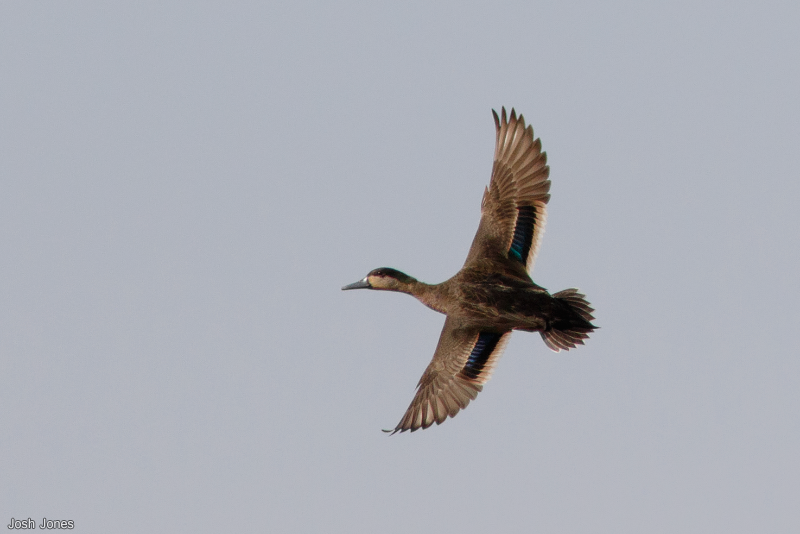
On 5 March 2016 the Red-billed Teal was seen alongside two hybrid offspring - both of which are pictured in the images above. The mixture of RBT/Mallard features is quite obvious.

If you consider this in addition to the fact that Red-billed Teal is an abundant species in Africa with a massive range, the fact that none have been known in captivity in Israel for over a decade (though of course this does not discount the possibility of an escape from another country), that the bird is extremely wary and does not allow a close approach whatsoever (atypical behaviour for an escape), that Israel regularly attracts Afrotropical vagrants (including several long-stayers at present) and already has an accepted record of this species, I believe the evidence points towards this being a wild bird, despite the IRDC's reported reservations ...

Tuesday, 2 February 2016

Japan 2015 day 12: Capes Nosappu and Kiritappu

30 December 2015

A group of three Red-crowned Cranes out on the ice from Furen Lodge was a nice way to start the day while enjoying breakfast, shortly followed by the first Steller's Sea Eagle of the day. After discussing our tactics one final time with Take, we were out the door and on our way to Cape Nosappu. With the New Year period a national holiday in Japan, no boat trips were running and so our best chance of alcids was going to be off the lighthouse at the Cape.

On arrival we quickly located five Red-faced Cormorants roosting among the hundred or so Pelagic Cormorants on their favoured stack just off the amusement arcade. Scanning out to sea and Spectacled Guillemots were immediately apparent, many flying north-west with others resting on the sea. The odd Pigeon Guillemot was picked out among them while the sea was littered with seaduck - mainly Black Scoters and Harlequins, but also some Long-tailed Ducks and a couple of Stejneger's Scoters too. We soon picked up the first of at least a dozen Ancient Murrelets, all quite close to shore and giving great views in between dives. Several Kittiwakes and Common Guillemots were also offshore.

This stack, just off the amusement arcade, holds a large roost of Pelagic Cormorants and is a great spot for Red-faced 


Adult (top) and two immature Red-faced Cormorants among the many Pelagic Cormorants

Just a few of the many Black Scoters off Cape Nosappu

A drive around the headland again failed to produce the hoped-for Asian Rosy Finch. Indeed passerines were very sparse on the ground out towards the windswept Cape with just a few small groups of Tree Sparrows around the villages looking cold and a little tired of life. Onnemato harbour held both Steller's and White-tailed Eagles as well as the usual gulls and ducks - including a showy drake Long-tailed Duck and a few juvenile Glaucous Gulls attending a putrid seal corpse that had washed up on the slipway. Bread seems to be extremely effective at drawing in gulls around Hokkaido's harbours and it was no different here, with the usual mix of Kamchatka, Slaty-backed and Glaucous-winged Gulls the subjects.

Glaucous-winged and Glaucous Gulls queue up for our popcorn

One thing we'd noticed was that the harbours on Hokkaido weren't perhaps as productive as we'd hoped/expected. Gulls, wildfowl and alcids were all present in disappointing numbers - presumably the mild winter (and resultant lack of ice) had something to do with it while in the case of the former, the lack of fishing/harbour activity (as a result of the New Year holiday) probably wasn't helping. Habomai held very little aside a few Black Scoters, Harlequins and a drake Common Pochard plus a couple of Red-crowned Cranes flying over; Hanasaki revealed a BrĂ¼nnich's Guillemot but little else.

Take had told us that Asian Rosy Finches had also been seen along the coastal stretch of Route 142, south of Hattaushi, and so we decided to head down there. Another long and fruitless walk through promising rosy finch habitat once again drew a blank - it was now Cape Kiritappu or bust. Arriving at the Cape mid-afternoon, we soon found our target - a flock of around 40 Asian Rosy Finches - attending feeders in the garden of the small hotel by the main road. Before the trip had commenced I'd cited this as one of the target species that I most wanted to see, so enjoying the finches in the warm light was a relief to say the least! Views were a little distant from the road - certainly no good for photos, but good enough through the 'scope - but they'd regularly get up and fly around, occasionally landing on the roadside wires and consequently affording a much closer look.


Excellent birds and a fine way to round off another bright but bracing day in stunning scenery, which was made all the better by another excellent meal back in the warmth at Lodge Furen!

Cape Kiritappu

Wednesday, 27 January 2016

Japan 2015 day eight: cranes at dawn, White's at dusk

26 December 2015

One of the numerous must-see wildlife spectacles of Hokkaido is the early morning roost of Red-crowned Cranes in the river viewed from Otowa bridge, south of Tsurui. We'd heard that the temperature needs to reach around -15c for steam to rise from the river and 'fortunately' Boxing Day morning proved one of those ball-clenchingly cold starts.


Though we all felt that the crane photo opportunities were a little overrated, there was no doubt that the hoar frost provided an impressive sight. Despite all my layers, I was freezing and extremely glad of the car and subsequent breakfast back at the hotel!

After breakfast we headed back to Kushiro harbour for another gulling session. Seven Harlequins showed included a showy drake while additional species to yesterday included a group of eight Black-necked Grebes and a number of Pelagic Cormorants.


Gull numbers were similar to the previous day although three hybrid Glaucous-winged x Glaucous Gulls were new, while the ubiquitous and characterful Large-billed Crows never failed to entertain.

Slaty-backed Gull 

Large-billed Crow

After having had our fill (and chilled to the bone by the biting wind) we decided to head back inland. Roadside fields along Route 240 just south of Tsurui held an impressive minimum of 195 Red-crowned a Cranes as well as half-a-dozen Whooper Swans.

Continuing north we were thoroughly disappointed to find Lake Kussharo entirely ice-free - a testament to the extremely mild winter experienced on Hokkaido up until the previous week. This unfortunately meant that the Whooper Swan opportunities were somewhere between sub-optimal and absolutely rubbish, although the birds themselves were brilliantly tame. Neighbouring woodland was quiet except for Treecreeper, Great Spotted Woodpecker and both Willow and Marsh Tits.

A little deflated, we made the short journey to our accommodation that night - the very quaint Gustaf Papilio guesthouse. On getting out the car I was thrilled to see a White's Thrush fly up in to a nearby tree, and soon we had all enjoyed views of the bird perched high up, watching us intently.

Over the next hour we were treated to simply stunning views of the thrush as it fed to within 10 metres of us. As with all thrushes a lack of movement and sound from us seemed to ensure the bird was more trusting and, despite the awful late afternoon light, we all managed some pleasing photos - definitely one of the birds of the trip!


White's Thrush - just stunning!

Tuesday, 26 January 2016

Japan 2015 day seven: cranes and eagles on Christmas Day

25 December 2015

An early flight from Tokyo saw us arrive at Kushiro airport by mid-morning and, with a few hours to kill before the daily feed was scheduled to take place at Akan Crane Centre, we decided to make the short journey in to Kushiro to explore the port area for gulls.

Although there wasn't much snow on the ground the skies were grey and the temperature hovering just below freezing, and it was no real surprise when it began to snow a short while after our arrival - my first truly 'white' Christmas!

Kushiro harbour was busy despite the date, with plenty of trawler activity attracting hundreds of gulls. Quickly we found our first Kamchatka Gulls of the trip off the main pier, with birds of all ages performing well for the camera as they came in for our bread and popcorn handouts.

Adult Kamchatka Gull

Rather unlike Kyushu, Slaty-backed Gull was by far the commonest species. Among the hundreds gathered were a few tens of Glaucous-winged Gull and about five Glaucous Gulls, with all three species looking particularly striking and imperious as the snow fell. Over the next hour or two we happily papped away in what was a great session for photography - despite the minor issues with auto focus caused by falling snow!

 Slaty-backed Gull appreciating our offerings

Slaty-backs chasing a dumpster truck out of Kushiro harbour in the snow

A couple of Black Scoter were seen distantly but the commonest duck in the harbour was Greater Scaup though there were a few Harlequin Ducks and Goldeneye present and about 10 Goosanders at the nearby river mouth. Our first Hokkaido eagle - 'just' a White-tailed - landed on the outer breakwater.

Female Greater Scaup

With time pressing we decided to head inland (via a food stop at 7-11; these convenience stores proved staple to our daily diet) to Akan. On arrival around 70 Red-crowned Cranes were showing very well from the viewpoint. By early afternoon the skies had cleared and the cranes looked simply stunning against the blue skies and snowy backdrop, even if the experience did feel a little dudey. Generally peaceful in their antics, scuffles and display would occasionally break out among the gathered birds.


At 14:00 the feed began and a bucket load of fish was thrown out. Within seconds up to five White-tailed Eagles appeared from nowhere, swooping down to grab the offerings and giving absolutely outrageous views as they did so. The cranes acted quite aggressively towards the eagles as a peaceful scene became utter mayhem in the space of seconds. The eagles, evidently wary of the cranes' flying limbs, rarely paused to enjoy their meals and soon flew off to the safety of nearby trees. This spectacle was over in little more than ten minutes, and serenity soon returned.


We enjoyed the delights of Akan for the rest of the afternoon, focusing almost entirely on photographing the cranes as well as we could. The light changed quite frequently as banks of cloud rolled over and mist occasionally began to rise, allowing for photos to be taken in a range of conditions.


I went for a little wander late on and came across a Grey-headed Woodpecker giving excellent views near the captive crane pens - the only individual of the trip. Other birds included Willow Tits, Jay of the race brandtii and Great Spotted Woodpecker.


With darkness falling we made the short drive to our accommodation in Tsurui where I was very quick to head for the onsen to warm up. After that we we treated to a superb Christmas dinner, consisting of several dishes of traditional Japanese cuisine - a fitting end to a fine first day on Japan's northerly island.