Showing posts with label march. Show all posts

Tuesday, 21 March 2017

17-20 March update

A fairly steady weekend, the clear highlight of which was my earliest ever Willow Warbler - a male in song on the boundary of the WWT on Saturday morning. Also new for me this year was a flyover Siskin. I had my second Wheatear of the year, another male, on 19th while other highlights at the WWT over the weekend included lingering Water Pipit, Jack Snipe and Pintail. I had at least one sighting of Peregrine and the drake Tufted Duck x Pochard performed particularly well on Sunday. Gulls were pretty unremarkable over the weekend.


The usual drake Tufted Duck x Pochard hybrid

Away from the WWT, the Yellow-legged Gull made appearances at Chiswick Eyot on Friday and Sunday, and I had a drake Mandarin fly over Lonsdale Road Reservoir on Saturday morning. Small gull numbers have really dropped off (to virtually zero) along the river, but large gulls remain fairly steady.

The regular 2cy Yellow-legged Gull at Chiswick Eyot

Monday, 13 March 2017

Early spring promise

The mild conditions of recent days have generated a rush of summer migrants, many of which are arriving days (even weeks) earlier than usual.

I had my first Chiffchaff of the year singing at Lonsdale Road Reservoir, Barnes, at sunrise on Friday morning - this quickly followed by the regular 2cy Caspian Gull frequenting the playing fields at Dukes Meadows. I still look at this bird sometimes and shudder a bit, as structurally I think it looks quite Herring-like at times. I guess it's probably from Germany.

It looks fine here, but sometimes this bird takes on an appearance quite unremarkable for cachinnans. I've never seen/heard it calling.

Plenty of gulls have been on the move in recent days - the warm conditions of Saturday and Monday in particular were good for observing visible migration, with Black-heads almost streaming east at times. Not a single bloody Med Gull, though. The wait for one on my patch goes on. A few gull rings included the usual NTGG birds, red-ringed 2cy Herring 'J+H' from Peter Rock's scheme in Bristol, yellow-ringed 3cy Herring 'Y.161' (from Rufforth, N Yorks), and the following two:

 Adult Lesser Black-backed Gull white 'A8CF', Fulham, 11 March 2017 - from Sussex but awaiting details on when it was ringed

3cy Common Gull green 'J88Z', Chiswick, 12 March 2017 
Ringed as a 1cy female at Stavanger, Norway, on 16.11.15 and still in the city environs in Feb 2016, this is the first sighting of it since (and the first away from SW Norway)

There have also been up to three 2cy Yellow-legged Gulls knocking about recently, all familiar birds from recent weeks, but no new Caspian Gulls in recent days.

2cy Yellow-legged Gull, Fulham, 11 March 2017. I first saw this bird at Beddington on 3 March.

Sunday was a real red-letter day. Murky conditions produced a fall of early-spring migrants at the WWT including a pristine pair of Garganey, a Sand Martin, three singing Chiffchaffs and a smart male Northern Wheatear. Meadow Pipit was notable, too. On a sunnier Monday, I had a Common Sandpiper on the river at Fulham.


Friday, 3 March 2017

Good gulling at Beddington

Thanks to a kind invite from David Campbell, I went to spent a few hours sifting through the gulls at Beddington. It was my first visit there since April 2007, the day after the Glaucous-winged Gull was seen, and it's fair to say the site has changed somewhat - not least the construction of a hideous incinerator that is set to be a massive and permanent blot on the skyline.

The morning produced nine species of gull - the usual five plus:
  • 2cy Caspian Gull: also seen at Rotherhithe by Rich Bonser on 26 February [and then by several observers at Thames Barrier Park on 4 March]
  • 2cy Glaucous Gull
  • 2cy Iceland Gull: regular bird that has been around all winter (I saw it on the Thames in Hammersmith in early December)
  • Five Yellow-legged Gulls (2 ads, 5cy, 2 2cy): one of these has been seen regularly by Rich, Dante, Jamie et al on the Thames in East London. Curious how they move round, and fascinating that they're being tracked so closely this winter.
2cy Caspian Gull - almost as big as a heron

Dumpy 2cy Glaucous

Monday, 25 April 2016

Cape Verde trip report

In March I spent a fortnight exploring the delightful Cape Verde archipelago with Neil Bostock and Dan Pointon. We were fortunate enough to clean up on all but one of the endemic species and forms - the only miss being Cape Verde Peregrine which, with no known sites, seems to require an immense amount of luck to connect with. Below you will find a comprehensive trip report including details of all these species plus the numerous other specialities and rarities that we encountered.

If you'd like the report in PDF format, or have any general questions about e.g. logistics, please email me.


Saturday, 2 April 2016

A few thoughts on the Israeli Red-billed Teal

In early March I spent a long weekend in Israel, where the primary target was the long-staying Bateleur (which we saw). A real bonus was hearing of the continued presence of the Red-billed Teal in the northern Arava, 're-found' by visiting Finns Seppo and Hannu and seen shortly afterwards by visiting Brits Chris Bell et al. As we were at the Arava junction of Routes 40 & 90 when Chris' SMS came through on 5th, we bolted straight up to Hazeva and saw the bird pretty well in the strong mid-afternoon light, though it was very wary and was mainly seen in flight.

Red-billed Teal, Hazeva, Israel, 5 March 2016

Long before the trip I'd been a fan of this bird being the real deal. Israel boasts the only previously accepted Western Palearctic record of the species (in June - July 1958) and of course has a strong track record with producing extremely rare sub-Saharan African vagrants. Barak Granit wrote an interesting article on the Israel Birding Portal website which coherently summarises where we are seemingly at regarding this latest bird. His conclusion was that it's ultimately still up for debate, though Barak seemingly falls on the pro-wild side (e.g. "An escape scenario is just plausible as well, but the evidence doesn't support such a scenario").


Red-billed Teal, Hazeva, Israel, 5 March 2016

Since reading this it's become apparent that some members of the IRDC are seemingly not keen on accepting the bird as wild (words such as "dodgy" have been used by the committee and apparently the suspicion is that it will be rejected). More digging seems to throw up two primary reasons for this:
  1. The bird is behaving in sedentary fashion (i.e. it has been in Israel for two years and currently shows no signs of leaving)
  2. The bird has hybridised with a Mallard
To me, neither of these factors suggest captive/escaped origin and are certainly not detrimental to the idea that the Arava Red-billed Teal is a wild bird. Personally I think it is disconcerting that anyone could be dismissive of the bird based on the above two factors, though of course others don't share my view. Allow me to elaborate ...

The bird's sedentary nature

Here I quote BirdLife International (2012): "This species is mostly sedentary or nomadic, but may disperse long distances (up to 1,800 km) in the dry season depending on the extent of flooding".

Red-billed Teal is a species that often moves based on the availability of water. If suitable habitat is present, it does not need to move. If water is not available, it has the ability to move large distances. If it is normal for this species to disperse the best part of 2,000 km in search of water, imagine what a vagrant might achieve? Red-billed Teal routinely occurs as far north as Sudan. From here it is really not that far to travel to southern Israel, particularly when you consider the Nile acting as a northward funnel for sub-Saharan species. If a vagrant teal is driven north by a lack of water, it could feasibly end up in southern Israel (as many other African species have previously). If it then finds a constant water source to its liking, as this bird has, why would it need to move? The current notion to reject the record based on its sedentary nature (a completely natural part of the species' ecology) therefore doesn't make much sense.


One should also consider other examples of long-staying African vagrants. Israel currently has one (the Bateleur on the Judean Plains has now been present for almost a year), possibly two (Yellow-billed Stork in Bet She'an potentially present a year or more?). Elsewhere there is a long-staying and regularly returning Grey-headed Gull in Italy (currently present for its fourth calendar year) and, as of March 2016, Cape Verde continues to host a single Black Heron (this bird having originally turned up alongside another in March 2011). Before this there was a Black-headed Heron there for over two years. These are just recent examples and there are no doubt many more.

Hybridisation

Barak Granit refers to the occurrence of hybrid offspring alongside the Red-billed Teal as "much more worrying", but I do not agree with this. Dabbling ducks (Anatinae) are notorious for rife hybridisation, particularly among vagrants. It is a fact of life that Anatinae are very much advocates of 'free love' - hybridisation between species occur in normal circumstances, and not just in a vagrant context (where a lost individual will naturally look to breed with its closest available relative, if possible). If this is genuinely being used as a factor against the Israeli Red-billed Teal then, using the same logic, we should look to reject all those American Black Ducks that interbreed with Mallards in Britain, Ireland, the Azores and so on. Similarly any vagrant American Wigeon breeding with its Eurasian counterpart (or indeed Green-winged Teal with Eurasian Teal etc) would therefore be discounted as a wild bird. The fact that the Arava Red-billed Teal has bred with a Mallard at some point is, in my opinion, normal behaviour for a wild bird and in no way should be viewed as an indication of a captive/wild bird. Hybridisation is a true red herring in the 'wild or escape' debate.


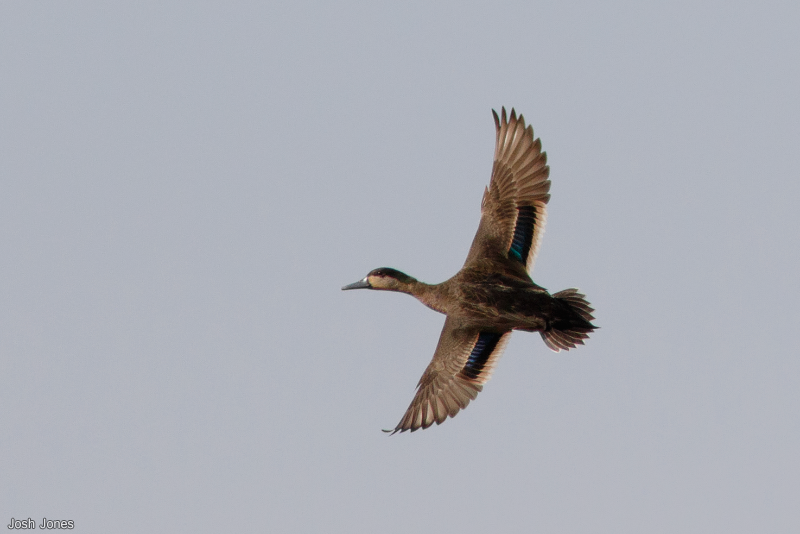
On 5 March 2016 the Red-billed Teal was seen alongside two hybrid offspring - both of which are pictured in the images above. The mixture of RBT/Mallard features is quite obvious.

If you consider this in addition to the fact that Red-billed Teal is an abundant species in Africa with a massive range, the fact that none have been known in captivity in Israel for over a decade (though of course this does not discount the possibility of an escape from another country), that the bird is extremely wary and does not allow a close approach whatsoever (atypical behaviour for an escape), that Israel regularly attracts Afrotropical vagrants (including several long-stayers at present) and already has an accepted record of this species, I believe the evidence points towards this being a wild bird, despite the IRDC's reported reservations ...

Saturday, 11 April 2015

France, Belgium & the Netherlands trip report

A brief report from our trip to France, Belgium and the Netherlands in early March 2015. You'll find details on Black Swan, Bar-headed Goose, Reeves's Pheasant, Chilean Flamingo, Black and Middle Spotted Woodpeckers etc. If anyone wants a copy, please email me.


Wednesday, 11 March 2015

Eurotrip

I've just had a most enjoyable weekend on the near-continent in the company of James Shergold and Harry Murphy. Our quarry was a mixed bag of distasteful introduced species and some altogether more appealing Continental specialities. On paper, I guess you'd have to say that the highlight of the weekend was the wintering Wallcreeper in Dinant, Belgium - after a fair old wait, we were treated to some excellent views of this brilliant bird as it alternated between the cliffs and the Palais de Justice. At one point, it even disappeared under the eves for as long as ten minutes before resurfacing! After seeing Wallcreeper at about a mile's range at Les Baux last March, it was great to finally see the species well.


I suppose I shouldn't be admitting to this, but I did get just as much of a buzz out of some of the introduced birds seen over the weekend. Our first stop on Saturday morning was Forêt d'Hesdin, where about a dozen Reeves's Pheasants were seen. Most were females, like this one:


We did see a couple of absolutely glorious males, including this one which briefly posed well for photos before scampering off in to the forest...


With the pheasant and Wallcreeper safely in the bag by mid-afternoon on Saturday, we decided to try a few woodlands in southern Belgium in the hope that we might be able to turf out Middle Spotted Woodpecker. And that we did without too much difficulty thanks to James' sharp eyes - a tick for Harry, as was Short-toed Treecreeper.


A successful first day was capped off with a few beers and fantastic tapas in a hotel near Utrecht. Leaving Harry - a testosterone-fuelled teen - to head off in to the night in search of local Dutch girls, James and I retired to the room for a good night's sleep - very much needed after a long day. Fortunately Harry returned in one piece, and was even up for our early start. Heading over to the east side of Utrecht, we met up with Thierry Jansen and friend who kindly showed us to a Black Woodpecker territory. It didn't take long before we were treated to good views of a male set to the backdrop of overflying White-fronted Geese and singing Woodlarks. Not a bad start to the day!

After this it was a case of 'eyes on the prize' as we re-focussed on two introduced species - Bar-headed Goose and Black Swan. The former was easily encountered near Culemborg while a pair of the latter were seen not far from Vianen, a third swan later seen in fields near Strijen.


Fortunately these were interspersed with more recognisable quality - namely a flock of Lesser White-fronted and many hundreds (thousands) of both European White-fronted and Barnacle Geese, plus Goshawk, Merlin, Med Gulls, Hawfinches and plenty more besides.


After dipping the Long-legged Buzzard at Maasvlakte we began the long drive south, calling in for these boys on the way - the less said about them, the better.


And so that rounded off a fine weekend on the European mainland. It was an excellent reminder of how much better birding can be just across the Channel and, even with the Cat Cs now safely planted on my Western Palearctic list, I'd happily return and do it all again. Very much cheap and cheerful, with some great birds to boot. It's my intention to produce a fuller trip report with GPS for some of the more interesting species (Reeves's, woodpeckers etc) in the coming weeks, so watch out for that.

Tuesday, 25 March 2014

Adders

After a fantastic weekend, I'm not entirely sure why I had never previously been keen to see Adders. For years, I've bumbled around various heath and downlands and never seen them, but never been particularly bothered. I was generally too busy seeking out avian year ticks - be it Tree Pipits, Woodlarks, Nightjars, erm... Golden Pheasant...

I guess age (maturity!) plays its part. Becoming a more open-minded naturalist (person) as opposed to mere numbers-driven birder. That and a bag full of nice new camera gear (macro lens, extension tubes etc)..!

 Male Adder, Holt, Norfolk, March 2014

I glimpsed my first Adder near my father's house last July - at Holt Country Park, in North Norfolk. It was really quite exciting, but frustratingly brief - a matter of seconds as it slithered off in to a dense patch of gorse and heather. Since then, I've wanted to see them well and, knowing that this time of year is best to connect as the snakes make the most of the first warming rays of spring sunshine, I've spent a bit of time looking over the past couple of weekends.

First up was Sunday 16th. Sunny and strangely warm for mid-March, I was rather too hungover to search properly - much to the amusement of Marc Read and Kit Day - and a day around Dunwich and Minsmere produced no more than a single Grass Snake. Dartford Warblers, a pair of Garganey and singing Firecrest were pleasant distractions, though.

The following weekend - i.e. the one just gone - I was due to be up in Norfolk, looking after my Dad's dogs. The weather forecast hadn't been good all week and I didn't hold much hope for a successful reptile hunt. As the weekend drew nearer, the forecast slowly improved and, as it turned out, it was actually a decent enough couple of days - while not as warm as the weekend previous, there were enough bright spells to coax out snakes. I must have seen a dozen Adders, perhaps more, during the course of the weekend. I quite enjoyed how predictable they were and, by Sunday lunchtime, I was beginning to know each individual by its physical features and, more importantly when considering photography, their behaviour too! Some were no-go's, clearly already too awake (and wary) to allow a close approach. Others would just sit there lazily, no more than a metre or two away, soaking up the sun. Occasionally they'd shuffle round to assume a more effective position, but most of the time they just lay there, motionless.

The most frustrating thing was that none were ever truly out in the open (or in ideal setting for really killer shots). Nevertheless, I'm happy enough with some of the pics obtained over the weekend. Most were taken handheld with my 400mm stacked with extension tubes (hence sharpness isn't quite there), but some of the 'snake in setting' shots were taken with the macro. I can't imagine going a spring without seeing them again, so plenty of time to improve...


Holt Country Park is as great site. As well as the snakes, Crossbills were ever present (no Parrots from what I could tell), Siskins and redpolls were consistently flying over, Woodlarks were singing and there were also a handful of Common Lizards zipping around.

Wednesday, 8 May 2013

Israel Trip Report, March 2013

Below is a copy of my Israel trip report for March 2013. As with my Moroccan article, you can read, download or share the document at your will. Hope it comes in handy!


Wednesday, 3 April 2013

Israeli migrants


We didn't exactly experience vintage spring migration in southern Israel during our trip - in fact it was generally quite poor. By the sound (and looks) of things, it's been a 'wet' winter in the Negev this year and as a result green areas are more widespread than normal, which obviously doesn't help to concentrate migrating birds. That said, one or two sites proved consistently productive throughout the week, with one these being the wadi at k76-77. Here I had four new birds (Asian Desert Warbler, Hill Sparrow, Bimaculated Lark and Cretzschmar's Bunting) among the good numbers of migrants, including as Tawny Pipits, Short-toed Larks, Lesser Whitethroats and wheatears of varying flavour - all grounded by the persistent (and often brisk) northerly winds during our trip. Despite plenty of birds, obtaining photos was actually pretty hard as most were pretty wary and would fly whenever you got within reasonable distance.

Hill Sparrow


Cretzschmar's Bunting


Bimaculated Lark


K19-20 were also pretty productive throughout our stay, although the species range was obviously quite different given the saltpans and other waterbodies here. It was the only place we saw Water Pipits regularly, while there were plenty of migrant waders including Marsh Sandpipers and the ditch at k19 held Baillon's, Little and Spotted Crakes with a Water Rail thrown in for good measure!

 Red-throated Pipit

 Water Pipit

Little Crake

Purple Heron

Wednesday, 27 March 2013

Israel


I'm fresh back from an extremely successful ten-day tour of Israel in which we saw almost all of the country's specialities as well as a few more of our targets and some great mammals. Much in the way I conducted my Californian posts, I'll be updating my blog gradually over the next week or two with various photographs - a full, detailed trip report will be available at a later date to view and download from my blog. Stay tuned.