Sunday, 14 October 2012

Birds still arriving

 It's been a pretty decent couple of days, although don't let the long lists of birds fool you - finding and seeing birds out here is just as hard (and exhausting!) as ever.

Yesterday was a day devoted to the valleys. We started in Fojo where I flushed the Wood Thrush from its usual spot 'behind the wall', although views were again brief and poor - frustrating! Waded down to the bottom of Fojo for the following hour or so seeing nothing. Pierre and I subsequently worked both Cantinho and Cancelas - again nothing save a (the) Barn Swallow flying north over Cantinho towards Lighthouse Valley.

It was turning in to a quiet day as I ambled my way through the upper fields during the evening, but the radio then crackled in to life announcing a wood-warbler - probably a Tennessee - in the middle fields! I headed down but missed the little critter, although as we were charging around the fields Pete re-found the Rose-breasted Grosbeak, which suddenly appeared in the tamarisks! Flying to a more distant patch of tamarisks, it revealed a bright red underwing (= male), and proceeded to give excellent views - a real bonus; thought it had done one! Long and short, there was no further sign of the Tennessee, which it was confirmed as thanks to more excellent shots from Vincent.

This morning started in Fojo yet again, although there was no sign of the Wood Thrush early doors and, while ambling down through the north slope of the wood, David's dulcet tones calmly relayed news of a Dickcissel in the middle fields, which he had just found. Mass panic once more as people ran, scrambled or simply fell out of Fojo in the bid to reach the nearest road. Half an hour later, we were all watching the bird - a first-winter male (quite a lot of yellow in the head pattern and breast) as it scrotted around with House Sparrows and regularly gave a high-pitched 'spink' from exposed
perches. Nice - much nicer than I had anticipated!


Other bits today included a brief view of the grosbeak again in flight and, this evening, excellent views of the Tennessee Warbler which was relocated in the middle fields by Eric. Although mobile, it was much better behaved than last year's bird but was silent. In other news, Pierre found a Philadelphia Vireo in da Ponte (seen, then gone again within minutes), while I walked all over the mountain and through lots of fields yet still failed to find a landbird of any kind. Nevertheless, a really showy juvenile White-rump was on the reservoir road as was a Semipalmated Plover, eating worms from a small wet patch by the side of the concrete - ridiculous! Also had a further four Semi-pees flying around the village and two Indigo Buntings in Lapa - they've been there for a few days now.

Juv White-rump on a hill.

Semipee in typical habitat (road).
Juvenile Cory's showing well by its nest in Lapa.


I wonder what tomorrow will bring. The wind is still in the west, and it's raining. Tomorrow promises calmer weather - maybe a good finding day...

Friday, 12 October 2012

Golden Wonder

I said around 24 hours ago that I'd update my blog no more than every two days. Well, today sure merits a bit of effort to throw something together

The day started as that previous, in the top part of Fojo looking for the Wood Thrush. No sign of the thrush but we did hear a couple of contact calls from the Blackpoll (not seen). Then the radio crackled in to life - "GOLDEN-WINGED WARBLER IN LIGHTHOUSE VALLEY" was repeated several times and everyone scrambled out of the wood and started to run north like a bunch of headless chickens.

Meeting Jens on the way there, it transpired that he had seen the bird briefly on a juniper bush before it had disappeared, not to be seen again. We headed down to the valley, but there was no sign of the beast - in the mean time, I managed to find a Red-eyed Vireo in dense vegetation midway along the valley and the French machine Pierre picked up a Black-and-white Warbler at the GWW site. The Black-and-white showed extremely well to most; I was one of the few people who had just a few calls and flight views - maybe I'll try it again over the next few days. In the meantime, the weather got pretty awful, with heavy rain and a strong westerly blowing down the valley and causing most of the birds to take cover. The next couple of hours were the most miserable I've endured on The Rock; we all ended up pretty soaked although eventually it did brighten up slightly and the Golden-winged search could begin again.

With the Black-and-white again showing in the improved conditions early afternoon, we were starting to believe the Golden-winged had done one. Deciding that the bird must have moved somewhere different, I elected to head up the valley and check some of the more sheltered areas beyond where I'd had the vireo in the morning. Plenty of searching but no reward; I was out of the valley a minute too late to see the bittern-type bird Stew flushed from fields on the south side. I continued to walk along the north side of the valley until, a further 100m up, I heard a wood-warbler give a sharp 'tsiip' call. Five minutes later, another 'tsiip' and then a flash of yellow - holy fuck! The bird landed on top of a hydrangea, and there was no mistaking it - black mask, black throat, ridiculous golden-yellow wings and forehead - it was the Golden-winged Warbler!

I couldn't find my radio in my panic and just started to wave like a maniac until those gathered down the valley saw me. Fortunately Ernie was on hand to put out my message on the walkie talkie and soon the twitch started to gather pace; thankfully the bird obliged and showed incredibly well for the next hour or so (down to 3m) - one of those monster WP birds that everyone dreamed (but no-one dared to believe) would turn up here. Simply incredible - words cannot describe! I even managed some digibinned pics; the fourth pic down shows the tiny hydrangea stand the bird spent about half an hour in.


On the way back, we had great views of the vocal Indigo Bunting at da Ponte bridge. Back in the village in the evening Pierre found an American Barn Swallow showing extremely well over the middle fields - a perfect end to a brilliant day.

Thursday, 11 October 2012

Corvo: days 1 to 2

I'm afraid there's not too much to blog about here; sure there have been some fantastic birds in the first 24 hours of being on the island but no images - not having an SLR essentially renders you useless on Corvo in terms of photos to show off.

After meeting Jens Søgaard Hansen at Lisbon airport early yesterday morning, we spent a few birdless hours on Faial before our plane to Corvo. The best bird was a Wheatear by Horta harbour - amazing to think this boy has just flown 2,000km to get here, and is now about to do the same distance across to Africa for the winter.

Greenland Wheatear at Horta, Faial.

Finally arriving on The Rock at around 15:45, we were in da Ponte by 16:30 where an incredibly similar situation to last year panned out. Within five minutes of arriving at the bottom of the valley, I had relocated Gordon Beck's Magnolia Warbler - no more than a few yards from where we first saw last year's Blue-winged. Incredible start!

Wasting no time, I ran up to Fojo to meet PAC in the hope the Wood Thrush might show. On the way, I had two Cliff Swallows feeding over fields near Poco d'Agua with four House Martins. Nice distraction, but was soon on my way again. To cut a long story short, we didn't see the thrush by 18:45 when we left although, on the walk down, the Indigo Bunting popped in to the usual tree at da Ponte - being a Corvo novice, another new bird for me.

This morning, first stop was Fojo. Within five minutes of arrival, I picked up an obscured bird scrotting around in the leaf litter in the 'usual' spot - sure enough, it moved slightly revealing itself to be the Wood Thrush as suspected, although views were distant and it quickly disappeared. Over the next two hours, I only had flight views of the bird as it zoomed past us down the valley - I'll be back there again tomorrow morning. In the meantime, man-of-the-moment Gordon Beck (along with Ernie Davis) had found a wood-warbler just 50m from where we were standing. Shortly after I heard a couple of contact calls and we scrambled up the slopes and quick were on to the bird. Christian and I enjoyed superb views at just five metres' range and, as Ernie and Gordon suspected, the bird was a crisp-looking Blackpoll Warbler - cracking!

The rest of the day was spent exploring the rest of Fojo, as well as do Vinte and the little wood on the slopes just south of there. I saw a grand total of nothing before heading down to the village late afternoon, where my plan was to explore the fields and perhaps photograph some waders. I popped back to my apartment (I have a bedroom, kitchen, bathroom and lounge all to myself! Photos soon) and managed to fall asleep until around 18:30. A quick walk down to the windmills produced nothing of note, and that was my day. With birds at a premium, my best discovery of the day were eight cannabis plants in do Vinte; evidently one of the islander's prized crop and, by the looks of things, several different strains as the buds were different shapes and colours. Sadly it later transpired that David had already found them yesterday, so not one for the self-found list..!

Cannabis close-up

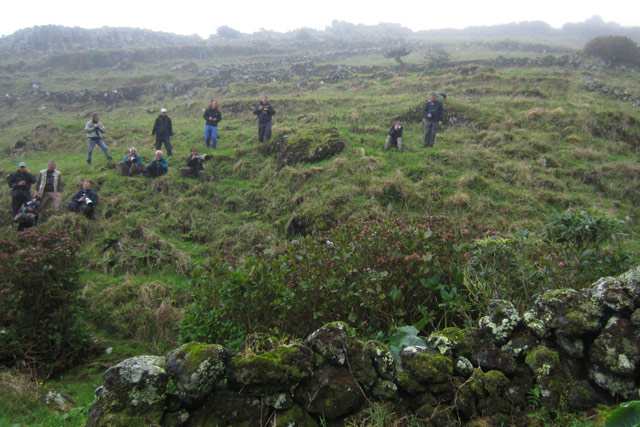
Yank habitat in do Vinte.

I've decided to update the blog every two days; internet is much worse than I remembered here and the connection in my room doesn't work at all. Hopefully have some more arrivals to report back on soon and, all being well, some photographs too.


Sunday, 7 October 2012

King Deal

Belted Kingfisher habitat, Lough Fee.

Like many others, I headed west towards County Galway for Saturday morning. Unfortunately, the near freezing temperatures and crystal clear skies in west Ireland revealed an inevitable outcome - Friday's Eastern Kingbird on Inishmore (a Western Palearctic first) had done an overnight bunk.

Nevetheless, massive consolation was provided by a magnificent male Belted Kingfisher in the heart of Connemara - just a few kilometres from a likely-looking sea loch which I have deliberately searched for the species both in this and previous autumns!

Describing a BK as 'consolation' simply doesn't seem fair. It was an awesome beast, and every bit as satisfying following the heartbreaking miss back in April 2005 (dipped it in Yorks and couldn't get a lift when it was in Aberdeens). Regularly giving its characteristic rattling call, it also spent a lot of time flaunting its crest and cocking its tail though remained wary and mobile throughout the morning, coughing up the odd pellet and occasionally also having a shit.


Amazingly, at around 12:45, it flew high - very high - until it became just a dot in the 'scope, disappearing over the mountains to the south of the lough. Heading round to Kylemore Lough, some 4km to the south, our team (John, Will, Pierre and I) spent some time searching for the bird without success until, at 13:25 when stood on the N59 bridge just east of Kylemore Abbey, PAC picked up the kingfisher flying in from the east! Giving stunning flight views, it flew right over our heads and continued westwards past the abbey out of view - we couldn't quite believe that, some 7km from the original location, a speculative stop had resulted in a relocation!

Although not seen again initially, a couple of teams scored on the lake by the abbey mid-afternoon but, after flying off, the bird was not seen again. Given how restless it seemed (perhaps not many fish in these loughs?), no sign doesn't seem surprising. Hopefully it is refound again for the Galway birders who didn't connect.

Finally, congratulations to Hugh Delaney et al. who are having an incredible few days on Inishmore. Fair play lads - you deserve it.

Now, get me to Corvo...

Tuesday, 2 October 2012

Weekend highlights


Didn't really look at many birds this weekend. Spent most of the time with the little critter above, my mother's new springer pup Molly. She's at that stage where she has to bite literally anything and everything, but otherwise is good as gold.

I did visit my old patch, Baston & Langtoft Pits, to reminisce. On 28th September 2007, I had two Great Skuas through here among an amazing passage of non-passerines. No such luck over the weekend, but Black-headed Gulls were evidently moving, bringing with them a few Common, Lesser Black-backed and this adult Yellow-legged:


Michahellis are always decent patchs bird for me as we don't get many gulls; September seems to be peak time as birds filter back southwards. Otherwise, there wasn't a lot doing aside 50 Golden Plovers, a few flyover Siskins, a Hobby and a Green Sandpiper. A Chiffchaff spent the weekend in our garden, and was singing during the sunnier spells. A big flock of Starlings on the patch failed to reveal the hoped-for Rosy Pastor, although they looked pretty smart in the autumnal sunshine.


I'm flying to the Azores on Saturday. Pretty pumped, just hoping for a westerly blow while I'm there this time. Last year, I only got the most pathetic of light westerlies during my visit which still delivered a couple of monster hirundines. The forecast looks decent for the next few days on Corvo although quietening down in to next week.

Monday, 24 September 2012

Semipalmated saviour...


.... of a pretty difficult weekend in Cork and Kerry. Also saw a really good looking near-adult Azorean Gull at Rosscarbery at dawn on 22nd, although it flew off pretty quickly. Much better than the 'thing' at Rainham. The best bird of Sunday 23rd was a Reed Warbler on Valentia Island.

Monday, 17 September 2012

American Golden Plover


Rich, John and I were fortunate to stumble across this newly-arrived juvenile American Golden Plover on Keel golf course, Achill Island on Saturday 15th. It's a particularly fresh individual, with smart golden upperparts - definitely the brightest individual I've seen.

I think it rates as one of the best birds I've ever seen in Britain & Ireland. Sure, it's 'only' an AGP, but is there anything better in birding than sitting in some far-flung destination watching a transatlantic vagrant at a range of five metres with your mates?! It's the fourth American Goldie that I've been involved in the finding of, the last of which was on the very same golf course - in fact, we found the 2011 bird just 50 metres from this latest individual!

Achill Island 2012, round one

The weekend has passed, and I've just enjoyed another great couple of days in County Mayo with John Archer and Rich Bonser. As always, we concentrated on the magnificent Achill Island - a wild and spectacular outpost in westernmost Ireland that must be an imposing (though attractive!) sight for Nearctic birds arriving in off the Atlantic. Over the past couple of autumns, I've been fortunate to find nine individuals of five Nearctic species on the island. With one eye on the remnants of Hurricane Leslie tracking northwards towards Iceland and the north of Scotland, the aim was to try and add to that tally.

Add to it we did. Bird of the weekend was a fine juvenile American Golden Plover on the golf course at Keel, which had evidently just arrived mid-morning on Saturday 15th and kept close to a European Goldie that was already present. On our first walk of the golf course hadn't revealed this bird and, with the addition of a flyover Pec Sand on the Sunday morning, illustrates why checking and re-checking sites in the west is crucial to finding birds. The plover was so good that it deserved its own post...

AGP + JJ

The Pec was one of two heard-only individuals over the weekend; the other was a single observer record for yours truly at Corragaun Lough which I could hear flying around as I crossed over the the channel - hands full of shoes and optics and water over the knee didn't help in the bid to see it. A Jack Snipe at Corragaun Lough on Sunday was a welcome Irish tick.

Nearctic waders are obviously great, but the find of the weekend goes to the juvenile Black-necked Grebe we picked up at Lough Doo on Saturday morning. This is a real mega out west; who knows where it has come from. We didn't see it Sunday but it was apparently still there.

Lough Doo Monster

The brief summary above has painted something of a rosy picture of the weekend. Don't get me wrong, I loved it - particularly watching the AGP in the glorious light of Saturday. But, it was hard work this year. Wader-watching in County Mayo is not for the faint-hearted. Last year's trip was exceptional; this year was much more typical! Furthermore, wader numbers seem poor this year - we had Dunlin at just a handful of the sites (Corragaun/Achill Sound/Roonagh), when in normal years they are at most sites. Although you don't necessarily need Palearctic waders to bring in the rares, it does help to concentrate them.

Thanks to Rich and John for a great weekend of company, and it was great to meet Nick Watmough on the Saturday as well as Achill semi-resident Michael O'Brien. Cheers guys.

Thursday, 13 September 2012

Mid-September Caspian Gulls

Today, I spent about 90 minutes in Butts Hide at Rainham, during which I saw the juvenile Baillon's Crake for about 3 seconds as it ran across a gap in the reeds. Nice bird, but I must admit I felt a huge sense of relief on seeing it. Why? Because it meant I could get back to the landfill site and look at the gulls, of course!

In two 90-minutes sessions today (mid-morning and early afternoon), I had at least five Caspian Gulls, with at least three 1cy birds seen. Interesting to see how worn all three were, being well advanced in their moult towards first-winter plumage.

Bird one was a really bulky-looking beast with a hefty bill. Note that the vast majority of the scapulars have been replaced, and also how worn the coverts are:


Bird two was perhaps the 'best'-looking of the lot, initially picked up flying around over the tip when the pale underwing could be seen with ease. A classic in all respects, this one is less advanced in its scapular moult than bird one, but note structure (long legs, parallel bill, rounded head etc). It looks really similar to this one I had in Peterborough last year.


Bird three was probably the most advanced of the bunch, with a whitish head and almost all scapulars replaced. Although superficially similar to bird one, there are differences in the moulted scapulars, and the bill is both a different shape (more pronounced gonydeal angle) and shows a more obvious pinkish wash to the base. Check out how long and spindly the legs are!


The other two birds were both 2cy, with one much more advanced than the other. Here is one of them, through the heat haze:


Also had this bird. At first, I thought it might be a Caspian Gull, but some features don't really fit - the bold anchors on the newly-moulted scapulars, the shortish legs, the dirty(ish) underwing etc. I guess it is likely a Yellow-legged Gull. Or perhaps even a Lesser Black-backed Gull. Thoughts and comments welcome.


Sunday, 9 September 2012

Portland, 8th September

Had a great morning around Portland and Weymouth yesterday morning. The birds were pretty scant, but some great insects and great weather not to mention catching up with friends, both new and old. I went back for second helpings of the Short-billed Dowitcher early doors; duly located it for those who had travelled down overnight. Nice views in the low light, but quite distant and often obscured. The sunrise was pretty spectacular; you can just make out the fog rolling down off the hills in to Weymouth Bay in the distance:


I headed back up to Portland at around 08:00 via a quick stop at Ferrybridge - plenty of Dunlin and Ringed Plover plus nine Med Gulls, but nothing more unusual. Unfortunately, fog had rolled in over the isle so I decided to go and chill out at the obs for an hour or so. Personal highlight was getting my grubby mits all over this Convolvulus Hawkmoth, very much reminding me of a sleepy week I spent at the obs in August 2005 with Stephen Menzie, Will Bowell and Kit Day when just about the only thing we saw of any note were a few of these crazy moths.


Otherwise, the night's catch was pretty unremarkable, although this L-album Wainscot was smart:


Martin also extracted a rather noisy female Sparrowhawk from the nets while I was there; this was the first time I'd seen the species in the hand.


With the weather clearing up somewhat, I decided to head up to Easton to look for the previous day's Monarch. Not too long after arrival, it floated up from nowhere before sitting atop a buddleia, warming itself up in the mid-morning sunshine. Eventually it began to play ball and I enjoyed some good views, even managing some decent video footage. Bit tatty at the wingtips but a spectacular species nevertheless.