Showing posts with label american. Show all posts

Saturday, 19 November 2016

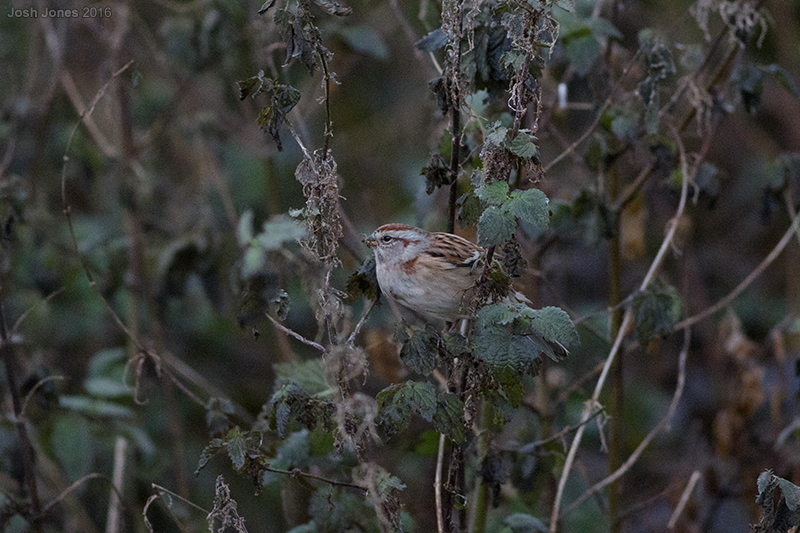
American Tree Sparrow in Sweden

Awful photos (ISO 5,000) of a brilliant bird in near-darkness late on Friday afternoon. Amazingly it did a Friday night bunk and a crowd of 400 (including Brits, Finns and Germans) all dipped. I think just about everyone had assumed that this bird was well settled and many seemed to think it might even stay all winter. It seems I was very lucky!


American Tree Sparrow, Staffanstorp, Sweden, 18 November 2016

Tuesday, 25 February 2014

Pale American Herring Gull


This beast was first found by Conor Foley et al. in a muddy field at the northwest end of Carrowmore Lake on Monday 17th Feb; Rich Bonser and I attempted to relocate it late afternoon on the Wednesday but failed, only to return mid-afternoon on Thursday to find it back in the same field. It's not with many gulls (up to 20 Herrings, and a couple of Icelands) and is extremely mobile - we saw it for a few minutes on Thursday before it flew off; extensive searching of the area then drew a blank for the next couple of hours until it magically reappeared in the same spot. Again it proved mobile, and we last saw it in another manure-covered field in the next valley to the north at Fallagh, where it stayed until clearing off just ahead of an heavy rain shower. The gulls it is with feed west to Barnatra village, where there are a couple of sheep fields. Guess it must get in those too.

Evidently a very pale bird, but these photos should show enough for the bird to be diagnosed as an American Herring (rather than Thayer's or a hybrid) - something reflected in field observations after quite a bit of head scratching and deliberation. It's a really big bird, quite thick-set with a strong, extensively pale-based bill - the latter is generally not evident in my photos due to being covered in cow excrement (though can be made out reasonably well in the penultimate pic)! Though it has a pretty well-defined greater covert bar, the rest of the upperparts are quite pale and concolorous, which was one of the primary reasons for our initial concern about it being smithsonianus. Just look at those scaps! The underparts are quite pale, but solidly marked nevertheless. In contrast, rump and tail pattern (and upperwing pattern in flight) look typical for smithsonianus. Eye-opening bird!


Tuesday, 12 November 2013

Sunday in Lisbon

First-winter American Purple Gallinule, Monsanto, Lisbon, 10th November

A somewhat uneventful Friday was gradually slipping by without incident until mid-afternoon, when I opened up my Facebook to see that David Monticelli had casually posted a crippling back-of-camera head shot of an American Purple Gallinule from Monsanto, Lisbon! Spluttering my mouthful of tea all over the table, I logged straight on to Skyscanner to check flight prices. Sunday was my only realistic option, and the prices looked good, so I spoke briefly with Rich Bonser and we decided to see if the bird was still there in the morning before booking anything. Later that evening, Rich called to say that he was going on the Saturday as Sunday's flight prices rocketed. I checked myself, and my heart sank - after an expensive autumn, a £500 day return was far too much to bother with, so I left things as they were and forgot about it for the time being.

Next morning, and Rich had text to say the bird was still present and looking well. Another check of Skyscanner for alternatives and it appeared that I could fly out Sunday, returning early Monday for a very reasonable price, and so I booked up late afternoon. David M had very kindly offered to stay in Lisbon an extra night to chauffeur us to the bird, and so I met up with him, Ernie Davies and Christian Leth (who'd flown in from Copenhagen) at Lisbon airport at around 09:30. Within an hour we were watching the gallinule, which was blogging around on the small pond at Parque Florestal de Monsanto. Unfortunately it was relatively distant and soon caught a frog - which it quickly demolished - before retiring to a patch of juncus to rest.


Here it stayed for much of the day, often looking pretty ill. In fact, it would let you approach to within a metre - at which range it was pretty clear that it was frightfully thin. It generally stood with its wings drooped, and we started to get pretty worried that the bird might not last the day. Frustrating for those among us with lenses, but more critically a grim state of affairs for the bird. Fortunately though, it did pick up again in the evening and began to feed/hunt. By this time, the sunlight had left the pond and my photographs aren't anywhere near as good as those taken by others.


After walking closer it was, at one point, feeding on seeds (and hunting frogs) less than a metre away from us! Much too close for a 400mm lens, so I put it aside and started filming with my iPhone! Even without bright sunlight enhancing the bird's colours, the close views allowed for intricate study. Purple, royal blue, cyan, green, yellow and even orange are present within millimetres of each other:


With the sun starting to sink, we left the bird at the pond's edge, seemingly in a better state than we had first feared. Alas it appears this was false hope for the bird was found exhausted and taken in to care on Monday. Though we all hope for a positive outcome, I'd hazard a guess that it's gone past the point of no return. A real shame, as it was a genuine stunner.


Huge thanks to David for hanging around in Lisbon and making it a great day, rounded off with a nice meal and a few beers in the centre of town.

Tuesday, 8 October 2013

If you go down in the woods today...

... Ribeira da Ponte, specifically, you'd have seen a fine first-winter male American Redstart. Found mid-afternoon by Gordon Beck very close to where he found last year's Magnolia Warbler, the bird showed very well through to early evening when we left. Though it would go missing for short periods and was quite mobile, it regularly re-announced its presence with a typical wood-warbler 'tsiip' and responded very well to tape. However, in the dark ribeiras, good photos are obtained only by the professionals - a bird constantly on the move up high in the canopy makes for a difficult subject for mere mortals such as I. Views through the bins were absolutely mind-blowing though. A great start to the trip - with good (not great, but decent enough) winds forecast, hopefully a few more birds yet.


Tuesday, 12 March 2013

American Robin


I finally managed some reasonable shots of American Robin on our final afternoon. This individual was spotted feeding on manicured lawns in a leafy suburb of San Francisco. Unfortunately the warm sunshine was evaporating the morning dew, creating some pretty intense heat haze and thus the shots aren't as sharp as they might otherwise have been.

Tuesday, 5 March 2013

Laguna Grande Park, Monterey

We found out about this site largely thanks to a wintering American Dipper, which showed astonishingly well during the evening of 21st (although in poor light) but had disappeared on 22nd. The low light meant shutter speed was slow and thus my shots are nowhere near as good as I might have hoped.


We also chanced upon a wintering Palm Warbler here, which showed well on both our visits. Surprisingly waterthrush-like in behaviour and appearance, and a good one to see in the flesh with future Corvo visits in mind!


Other common birds included Pine Siskins, American and Lesser Goldfinches, Ruby-crowned Kinglets, abundant Yellow-rumped Warblers plus this Downy Woodpecker:


...and plenty of House Finches including this smart male:


Tuesday, 16 October 2012

Quiet 15th, crazy 16th

Another couple of days to report back on. Yesterday (Monday 15th) proved a difficult day. I started in the Lighthouse Valley with PAC and Eric; we had 'my' Red-eyed Vireo from GWW day, but little else. Climbing out the valley, we were greeted by a text suggesting a possible Mourning Warbler in da Ponte. Needless to say, we spent the rest of the day there - no MW, and not much else to rave about.

Today was much more promising. Many went back to da Ponte for second helpings of the MW dip. I continued on to Fojo, and spent the morning walking up and down the slopes about the picnic area. In four hours of staring a dense laurels, I saw precisely nothing so headed up and out of the wood and on to the lighthouse road. Meeting Ernie Davis, we decided to work the upper part of Poco d'Agua and see what happened. Absolutely nothing, to be precise! Although both Hannu and Ernie saw a thrush with a red tail, which we will all check out tomorrow morning.

I decided to head towards the reservoir, working the upper parts of Lapa as I headed there. Nothing in Lapa, but 9+ White-rumped Sandpipers and 2 Semipalmated Plovers bombing around the reservoir. Finally, Hannu located the Solitary Sandpiper showing well on the small muddy patch of the north side of the reservoir which eventually showed to two metres..!

Hannu and the Solitary.

My heart sunk shortly after when Vincent and Pierre found a Common Yellowthroat in the yams at the top of Lapa; I'd walked this spot just an hour before and had nothing but a Snipe - bollocks! Decided to head back down and try it out, while PAC went up towards the reservoir. After a few minutes there was a loud 'tsiip' and Vincent and I were expecting the yellowthroat to pop back out. No sign, so I walked up the valley and pished - bang! Small warbler with white spots in the outer tail feathers... it lands... fuck! Northern Parula! I was more relieved than anything, being happy just to have finally found something decent out here. The bird was mobile, although showed well on and off over the following couple of hours.

Back down in the village, Gordon, Ernie and I set out on an evening lap of the airfield to see if anything turned up. One of the gulls hanging in the wind over the west end of the airfield this evening proved to be a messed up, near-adult Herring-type - further scrutiny when it finally landed on some rocks (after floating around on the sea with wings open, looking half dead!) showed plenty of features suggestive of American Herring Gull - which it must be, given the weather. As we watched this bird, Ernie radio'd with news of a Canada Goose flying west towards us from the windmills! Sure enough, the goose flew over our heads shortly afterwards, before turning back and heading out to sea to the southeast. Looking at the size and structure (as well as dark breast) it looks a decent candidate for interior (Todd's), not too dissimilar to the bird I found in Co. Mayo in January.

Knackered smiths and big breakers

Digibined record shot; note the mantle colour looks so dark as the bird is soaked!

Presumed Todd's flying around over the airfield.

In the meantime, Gordon had found a moribund teal species by the windmills and had a Laughing Gull fly past! Vincent and I headed round for the teal, which I was easily able to pick up and put in my pocket. Although far from an obvious candidate, it looks likely thay this bird is a female Green-winged Teal (not surprising given the weather), although we'll take some feathers for DNA analysis to make sure either way. I took the bird down to the SPEA girls, who will rest it overnight and let us know how it is in the morning - it seems the bird is more tired than unwell, as it had plenty of fat left and seem fairly spritely despite being unable to fly off. Fingers crossed it makes a full recovery; a nice way to end an eventful day which ended in a genuinely dynamic manner - everyone seems optimistic that new birds will be found over the next couple of days...

The teal in the safe hands of SPEA.

Monday, 17 September 2012

American Golden Plover


Rich, John and I were fortunate to stumble across this newly-arrived juvenile American Golden Plover on Keel golf course, Achill Island on Saturday 15th. It's a particularly fresh individual, with smart golden upperparts - definitely the brightest individual I've seen.

I think it rates as one of the best birds I've ever seen in Britain & Ireland. Sure, it's 'only' an AGP, but is there anything better in birding than sitting in some far-flung destination watching a transatlantic vagrant at a range of five metres with your mates?! It's the fourth American Goldie that I've been involved in the finding of, the last of which was on the very same golf course - in fact, we found the 2011 bird just 50 metres from this latest individual!

Achill Island 2012, round one

The weekend has passed, and I've just enjoyed another great couple of days in County Mayo with John Archer and Rich Bonser. As always, we concentrated on the magnificent Achill Island - a wild and spectacular outpost in westernmost Ireland that must be an imposing (though attractive!) sight for Nearctic birds arriving in off the Atlantic. Over the past couple of autumns, I've been fortunate to find nine individuals of five Nearctic species on the island. With one eye on the remnants of Hurricane Leslie tracking northwards towards Iceland and the north of Scotland, the aim was to try and add to that tally.

Add to it we did. Bird of the weekend was a fine juvenile American Golden Plover on the golf course at Keel, which had evidently just arrived mid-morning on Saturday 15th and kept close to a European Goldie that was already present. On our first walk of the golf course hadn't revealed this bird and, with the addition of a flyover Pec Sand on the Sunday morning, illustrates why checking and re-checking sites in the west is crucial to finding birds. The plover was so good that it deserved its own post...

AGP + JJ

The Pec was one of two heard-only individuals over the weekend; the other was a single observer record for yours truly at Corragaun Lough which I could hear flying around as I crossed over the the channel - hands full of shoes and optics and water over the knee didn't help in the bid to see it. A Jack Snipe at Corragaun Lough on Sunday was a welcome Irish tick.

Nearctic waders are obviously great, but the find of the weekend goes to the juvenile Black-necked Grebe we picked up at Lough Doo on Saturday morning. This is a real mega out west; who knows where it has come from. We didn't see it Sunday but it was apparently still there.

Lough Doo Monster

The brief summary above has painted something of a rosy picture of the weekend. Don't get me wrong, I loved it - particularly watching the AGP in the glorious light of Saturday. But, it was hard work this year. Wader-watching in County Mayo is not for the faint-hearted. Last year's trip was exceptional; this year was much more typical! Furthermore, wader numbers seem poor this year - we had Dunlin at just a handful of the sites (Corragaun/Achill Sound/Roonagh), when in normal years they are at most sites. Although you don't necessarily need Palearctic waders to bring in the rares, it does help to concentrate them.

Thanks to Rich and John for a great weekend of company, and it was great to meet Nick Watmough on the Saturday as well as Achill semi-resident Michael O'Brien. Cheers guys.