Showing posts with label bunting. Show all posts

Sunday, 22 January 2017

Pine Bunting!

After the autumn's record influx, it seemed inevitable that the odd Pine Bunting would be unearthed in the British countryside this winter. By the end of 2016 that inevitability had not yet materialised, but it was on New Year's Day that a female was found at Venus Pool, Shropshire. Unfortunately it proved extremely elusive and was seen well only the following day; it was reported on subsequent dates but always briefly and many left the site having dipped.

Pine Bunting, along with Aquatic Warbler, has sat at the top of my 'most wanted' list of birds to see in Britain for years now. I dipped the Choseley bird twice back in the day and, unable to get a lift to Worcestershire in 2005, it's been a long wait for another. I've always found it an interesting species - females are subtle (thus providing a genuine identification challenge), there's always the hybrid issue to consider and overcome, and males in particular are really dapper birds. It's also one of those species that you feel anyone has a fighting chance of finding given their penchant for turning up at otherwise uninspiring inland sites. The problem these days, as much as any other, appears to be finding flocks of their fast-declining western counterpart, Yellowhammer, to search through. It's quite depressing how depleted this species is in the British countryside even compared to when I started actively birding in the early to mid-2000s, when its populations were already severely reduced from historical levels.

New Pine Buntings have been popping up all over Western Europe on what seems like a daily basis this January, and another in Britain never seemed far away. Step forward Chris Gomersall, who did a fine job by pulling out a stunning male from among a big Yellowhammer flock at Dunnington, just east of York, on Friday.  The bird showed a few times over the Saturday and so I decided to head for the site early on Sunday in order to try my luck. The main problem was that I didn't have my telescope, and this was most definitely a 'scope job. On arrival a big crowd of birders were looking in to a rough field at several hundred metres' range - not something my 8x bins were ever going to deal with!

After a nice catch-up with Andy and Vicky I decided to make use of myself and head off to explore the surrounding fields, in the hope that I might stumble across birds that were remotely close enough to check with binoculars. The sheep field where the bird had been seen on Saturday seemed a good place to start. Quite amazingly, no one else was looking and so I carefully walked the field edge, sifting through the various species feeding in the field or sitting in the hedgerows - there were plenty of Yellowhammers, a few Reed Buntings, various finches and lots of winter thrushes.

The whole place seemed very 'birdy' and undisturbed, so I decided to sit down by the fence. This caused the sheep to spook and consequently flushed everything up in to the trees, but soon enough birds started dropping back down. I sat there for about 10 minutes before, suddenly, an unmistakable brown-and-white head pattern appeared among a small group of Yellowhammers at 50 metres' range. No doubt that it was the male Pine Bunting, and in fantastic light too! The bird was extremely wary and mobile - even the excited reach for my camera caused the flock to pop back up in to the trees - but soon it came back down. I made a few calls to friends in the main crowd and awaited their arrival.


Uncropped (top) to ultra-cropped versions of the same shot ... the Dunnington Pine Bunting

I had a few brief views over a five-minute period, with the bird landing no more than 20 metres away at one point. Unfortunately it sat still, facing away, for about five seconds before bolting off again. If only it'd fed there for a little longer and turned to profile..!


The number arriving birders was never going to help - the increased movement and commotion clearly wasn't to the feeding flock's taste and they quickly moved away down the hedgerow, back west towards the original field. I always find bunting flocks can be very nervy and thus the utmost care needs to be applied when trying to watch them, even when on your own. The birds were very edgy with just me there, so it's no real surprise that they moved off when more started to arrive. A shame, but I think the bird was seen on back over in the other field on a couple of occasions shortly afterwards. Clearly this is a challenging bird to see but the corner of the field at 53.9679, -0.9678 seems to be a good area for feeding birds, and is well worth focusing on if visiting in the coming days. The Yellowhammers (and Pine Bunting) spent most of their time feeding around the fallen tree about 30m along the hedgerow running WSW back towards the farmhouse.

Given the autumn's arrival and the numbers just over the Channel in e.g. the Netherlands, there must be so many out there waiting to be found in unsuspecting patches of the British countryside. Hopefully a few more individuals of this brilliant species might be found before spring.

Friday, 15 January 2016

Japan day two: Tokyo

20 December 2015

Unfortunately my 'capsule' was opposite possibly the loudest snorer that I've ever encountered in my life and that, coupled with jet lag, meant that I didn't really sleep all that much overnight and was therefore pretty happy when the clock finally ticked round to 5.30 am.

After a shower I left the hotel and, grabbing breakfast on the way, caught the subway to Meiji Jingū. The park and woodland surrounding the shrine was only completed some 90 years ago but is very well established and a great location for city birding. Not long after arriving and passing through the impressively large Cypress torii (gate) I was enjoying a flock of Dusky Thrushes bathing in a stream as well as my first Varied Tits high in the canopy. Further strolling produced good numbers of the commoner woodland species, including plenty of Oriental Turtle Doves.

The shrine itself was not only beautiful but very peaceful early morning, though this had changed by the time I passed again 90 minutes later. As the name would suggest it is a shrine dedicated to Emperor Meiji and seems extremely popular with both tourists and locals alike.

The more open areas on the north side of the park produced a slightly different selection of species, including my first Bull-headed Shrike and a showy pair of Black-backed Wagtails, one of which posed for photos.

Black-backed Wagtail

A few Spot-billed Ducks were floating inanely on the nearby pond, Pale Thrush was seemingly quite common and I glimpsed a Goshawk flying over. Japanese White-eyes afforded some of the best views I had all trip, though I never managed any pleasing photographs.

Japanese White-eye

With the 9 am opening time approaching, I headed back to the gardens south of the shrine. Not only does this area tend to be quieter (a 500 ¥ entrance fee seems to put the masses off) but the birds here are fed regularly, meaning they're much more confiding. Indeed, the Varied Tits feed out of people's hands while my first Black-faced Buntings fearlessly scrubbed around on the floor to within a few feet.


Black-faced Buntings at Meiji Jingū

Varied Tit - another species I failed to photograph satisfactorily, this being my only decent image

My main target here was Grey Bunting, a species that can be elusive and therefore tricky to catch up with. Various items of gen I'd gleaned suggested that the buntings visit the seed put out for them but that didn't seem to be the case today - just the flock of Black-faced plus a couple of brief Oriental Greenfinches. Wandering around the various trails I eventually found a pair of Grey Buntings feeding in the inflow channel at the east end of the main pond, giving distant (but decent) views just in time for the arrival of Rich and Mick, who'd flown in overnight from Vienna.

Back at the seeded area females of Red-flanked Bluetail and Daurian Redstart appeared before our cue to leave for Haneda airport, where we saw a female Blue Rock Thrush a short while before catching a late afternoon flight to Kagoshima, on the southern island of Kyushu.

Tuesday, 16 June 2015

A memorable June weekend

No time for words, so I've summed up my long weekend with in photographs.

male Eastern Black-eared Wheatear, Acres Down, Hampshire, 13 June

male Cretzschmar's Bunting, Bardsey Island, Gwynedd, 15 June

male Melodious Warbler, Hampton in Arden, West Midlands, 15 June

Sunday, 12 April 2015

Easter Lapland Bunting


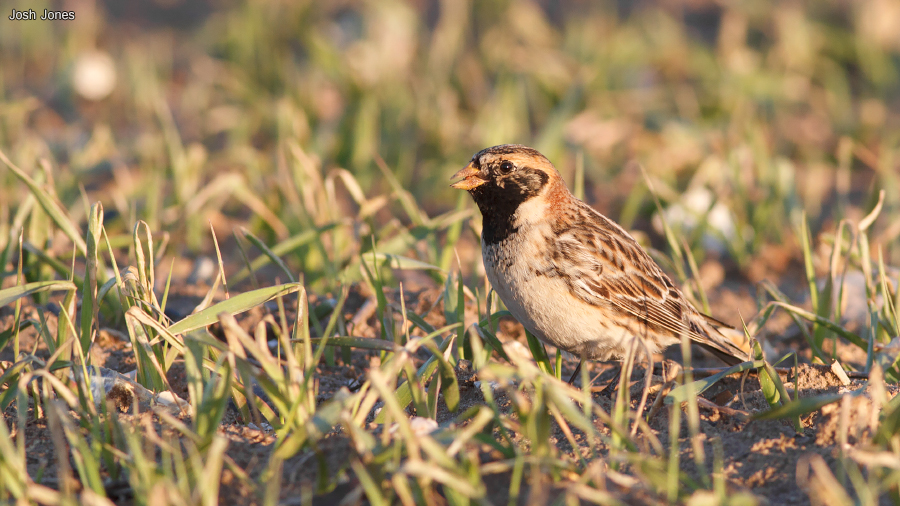
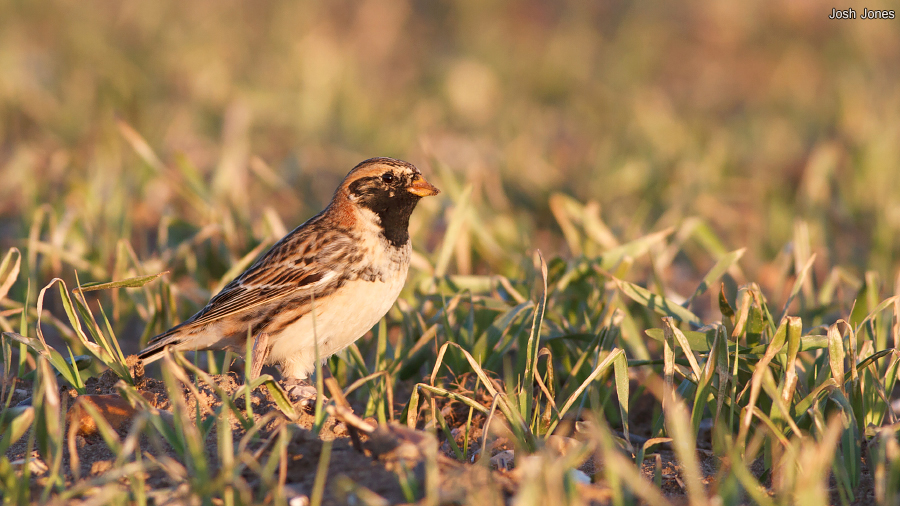
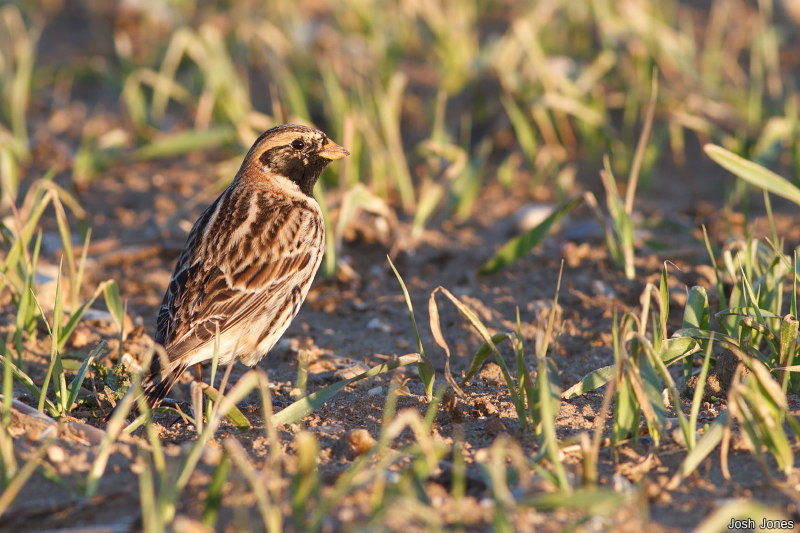
I don't really see that many Lapland Buntings and this male at Weybourne, Norfolk, on 5 April was the first I've seen in anything approaching summer plumage. This cracker was characteristically confiding yet continuously on the move, shuffling around among the wheat and thus rarely staying still for a good shot. By the time I'd found it the sun was already low and time was against me - images aren't as good as they could be, but I'm still happy to have managed a few given that I hadn't seen any of these birds, present several weeks, published anywhere else.

Lapland Bunting

Lapland Bunting

Lapland Bunting

Thursday, 9 October 2014

That's more like it ...

Today I started up at the reservoir again, hoping for better light and better pics of the pipit. Neither came - in fact it seems the pipit has gone. After I meandered down the seismic station valley on the west side of the island - a sure fire spot for newly-arrived Yanks, but nothing doing today.

After traversing back around the reservoir hill, I decided to cut across to the white obelisk on the hill to the south and then drop in to the so-called 'Tennessee Valley', named as such because the main man Pierre-andré found a Tennessee Warbler there in 2011. There's a great patch of junipers on the steep slopes here but they're very hard to access due to brambles, difficult terrain etc. As I worked my way down the wind dropped, the sun came out and it became very birdy - Chaffinches, Canaries and Blackcaps all around, and very showy.

Climbing over a wall, I said aloud [talking to oneself is the norm here]: "I'm going to find something here". Honestly, no more than a few seconds later, I put my bins up to scan a flock of Chaffinches sat on a juniper and there among them was a bigger bird with a stripy head and dock off bill - bloody Rose-breasted Grosbeak!


It soon flew but better views quickly followed, made only better by an interesting passerine that flew by with a high-pitched tick. Landing on a hydrangea for a couple of seconds, I was utterly ecstatic to see it was an Indigo Bunting before it dropped in to cover! How is this happening when the forecast has been so uninspiring?! As it turned out the bunting made a very quick exit - I only saw it once again in flight as it zoomed off up the valley. I had some decent views of the grosbeak over the next half hour but it quickly went more elusive - only Bosse saw it before the wind got up again and it vanished.

Thrilled with that I headed off down in to the valley itself where Daniele O, Marcin from Poland and Gary F were making their way up for the grozzer. I stopped for a roll (ham and cheese of course) before continuing. It was shortly after the roll that a Willow Warbler began calling to my right. Willow Warbler is a good bird here and this was the first of the autumn, so naturally I turned to look for it. What I hadn't bargained for was a yellow and black bird staring back at me with a beady black eye no more than ten metres away. Fuck about! It's a Scarlet Tanager! I was straight on the radio and Daniele, Marcin and Gary were quickly by my side, securing some great shots to document the beast.


The tanager turned out to be the most confiding bird of the afternoon and was twitched by most of the birders on the island - I believe it was still showing well at times late afternoon. Also this afternoon Bosse found a Red-eyed Vireo in tamarisks at the west end of the airstrip (a classic spot for newly-arrived birds) and a Lesser Yellowlegs was frantically flying around the village looking for somewhere to land - a nice discovery for Hugues.


So it seems, for reasons I can't quite fathom, we've had a nice arrival of Nearctic birds today. Long may it continue!