Thursday, 6 January 2011

Redpolls, 6.1.11

After reading with interest about local birder Richard Astle's flock of 80 redpolls at Bainton Pits, in the south of the Deepings Area, I decided to head home for a long weekend.

Got to Bainton about half nine this morning, but the sunny weather which was forecasted had failed to materialise. Nevertheless, a few Bullfinches and Goosanders made the walk around the Main Pit interesting. Got to the spot where Richard Astle had seen the redpolls shortly after, and sure enough a flock of c.100 was noted flying out of birches by the hard standing. What I was not expecting was to see, in my first scan, was a flock that appeared to contain a vast majority of Mealy Redpolls! Astonishing - it really was a case of 'spot the Lesser' - something I've never experienced in Britain previously. Looking back, it seems over three quarters of the flock were Mealies which, by my estimates, meant there must be a minimum of 70 present! It soon occurred to me that there would be a good chance of picking up an Arctic Redpoll, so I started sifting through the birds.


Sounds easy enough, but the birds were typically skittish, mobile and flighty. This meant that only portions of the flock could be searched properly at once, and the poor light didn't help either. Nevertheless, I picked up a good candidate after half an hour or so. Sure enough, further views revealed just a single, thin streak on the longest undertail covert and a large, unstreaked white rump. The bird was strikingly pale, with frosted upperparts and clean underparts. A couple of thick streaks on the flanks would be towards the streakier end of Arctic Redpoll, but everything else fitted. Brilliant - a self-found Coues's Arctic Redpoll!

Sadly views were brief, and this is the only photo I really managed(!) - the others haven't come out well at all, which is frustrating:


A second bird, which may be a dull 1st-winter female type, was also seen briefly and looked fairly promising. No photos, sadly.

So, a frustrating rather than satisfying day. The flock was seen again briefly early afternoon but not well, and the birds flew off high towards Helpston village in the afternoon. Shame! With so many Arctics being found at the moment, I suspect there may be more than one bird here...

Saturday, 25 December 2010

Christmas birding 23rd - 25th Dec

More birding over the past couple of days. On 23rd, I went to Dogsthorpe Tip for a few hours. Amongst the many thousands of gulls present, there was a 1st-winter Caspian Gull (which I had on the tip briefly about 10:30), and then this bird:


To me, this a fairly 'good' Glaucous x Herring Gull hybrid, and has arrived with large numbers of argentatus which look like they have come from a long way north. In my opinion, there are a few features that rule out the leucistic Herring Gull theory:
  • boldly-patterned greater coverts and tertials
  • extensive pale chevrons on primaries
  • scapular pattern lacks obvious chevrons
  • tail band is weak and broken
  • head and bill structure, at times, looking quite Glaucous-like
  • 'broken' eyering (see final picture)

BLGP and Baston Fen continue to hold 8 Bewick's and 3 Whooper Swans:


... and were joined by two lovely adult European White-fronted Geese, one of which is below:


All the wildfowl above are still present as of today (25th December), as well as good numbers of Wigeon and the odd raptor and wader.

Season's greeting to all.

Wednesday, 22 December 2010

21st - 22nd Dec

Nice couple of days birding around the local area. Yesterday (21st) was really good; a spectacular hoar frost combined with very calm conditions allowed for some excellent birding opportunities.

On Deeping High Bank I had 5 Goosanders, 11 Bewick's and 2 Whooper Swans. The river was completely frozen save one or two duck-filled patches like this:


Baston Fen and my local patch (Baston & Langtoft Pits) gave a further 8 Bewick's and 3 Whooper Swans, as well as ringtail Hen Harrier, 3+ Short-eared Owls, a couple of noisy Curlews, Water Pipit and a few other odds and sods, which all gave for some excellent cold weather birding.


Today was slightly less productive in heavy snow showers and poor visibility, but at least it was milder (0 celsius rather than -5!). The Bewper Swan combination was still chilling out (literally) on the patch, and a nice finch flock contained a few Siskins (mostly Goldfinches). No redpolls. Gargh! I also had 4-5 Buzzards around, and 540+ Wigeon on the two small holes of unfrozen water on ARC Pit and the Old Wader Scrape. There are flocks of Skylarks everywhere.

A nearby game strip between Greatford and Baston produced alot of passerines this evening primarily made up of Corn Buntings, Yellowhammers and Chaffinches, but I also had 2+ Bramblings and a redpoll over. Only had my bins and didn't have alot of time but will check it again in the next few days to see what else is lurking there.

Monday, 20 December 2010

Glaucous Gull, 17-18th December

Back in the Peterborough area for Christmas now, which allows me to get out and do some local birding for a change. At the time of writing (2oth Dec), everywhere has frozen up in what is one of the coldest Decembers for a century. Water-based birding is therefore out of the question, so I've stuck to what I know best around here - gulls. Within five minutes of arriving at Dogsthorpe Tip on Friday, I had a winger flying around - from poor flight views it looked like a Glaucous. Further flight views with Mike Weedon confirmed it was indeed a Glauc, but I didn't see it again in three hours.
Mid-morning on Saturday, Mike rang to say the bird was still at the tip, and was indeed a 2nd-winter with unusually dark iris. Turns out it was the same bird which has been touring the Midlands over the past couple of weeks:

Dec 4th: Appleford Pits (Oxon), then roosted at Farmoor Reservoir that evening
Dec 12th: Throckmorton Landfill Site (Worcs)
Dec 13th: Stubbers Green (West Mids)
Dec 14th - 15th: Dosthill Lake (Warks)
Dec 17th - 18th: Dogsthorpe Tip (Cambs)

Couple of photos:


Otherwise, there was nothing really of note, save a few nice argentatus Herrings such as this pale individual:


I've also been trying to track down redpolls locally but so far it's been very frustrating.

Best of the Rest

Been a while since I've updated this, so here's a quick blast through the rest of the autumn in pictures:


Black-eared Wheatear, St. Mary's Scilly, October


Myrtle Warbler, Cape Clear, Co. Cork, October


American Bittern, Walmsley Sanctuary, Cornwall, November


Green Heron, Heligan, Cornwall, November


Ferruginous Duck, Kingsmill Reservoir, Notts, November

Monday, 4 October 2010

September 2010

Another September flies by, and here are some of the highlights...


1st-winter female Northern Parula, Tiree Argyll; 28th September
A morning flight from Glasgow on the 28th saw us spend 24 hours on this beautiful, yet wild, island. In addition to the obvious highlight above Buff-breasted Sandpiper, scores of Lapland Buntings, and superb views of Otters made for an excellent first visit out here.


1st-winter Alder Flycatcher, Blakeney Point, Norfolk; 27th September
Following a busy (and heavy) weekend, I eventually emerged from a pretty grim hangover to tackle the point on the bird's last afternoon. Being very mobile and active, it was perhaps not surprising there was no sign the following morning.


Adult drake Black Duck, Ventry, Co. Kerry; 16th September
A three-day trip over to Ireland over 14th-16th September yet again proved to be a general success. Whilst many of the sites around Dingle were quiet for birds, it was pleasant to see the Black Duck back near Cuan Pier after an absence of almost two years!


2CY American Herring Gull, Blennerville, Co. Kerry; 15th September
Although this bird is reported with some frequency (and has been since it first appeared in July), it can be very difficult to catch up with as its appearances are strictly determined by the tide. Low tide is essential, when it feeds in the channel upstream of the windmill, although it regularly disappears into smaller creeks for extended periods of time. High tide is a write-off as the bird seems to head off towards Tralee town over the period (where it goes exactly is still a mystery). In at least five attempts to see this bird, I've only connected twice. Photo is poor but at least illustrates how much the bird had moulted since August, and is now well on the way to acquiring a most striking second-winter plumage.


Juvenile Pectoral Sandpiper, Leam Lough, Co. Mayo; 14th September
An impressive first day in Mayo saw myself and Oliver Metcalf heading south to Dingle with high hopes for the morning of the 15th - in hindsight, we perhaps should have stayed and focussed on the former! This was one of a couple of Pecs seen on 14th, the other being a find on Achill Island (alongside 2 Buff-breasted Sandpipers).


Adult drake Ring-necked Duck, Achill Island, Co. Mayo; 14th September
Our team found this bird back in late August, when plumage was much more drab (see older posts for a pic). Rapid moult has led to it acquiring a much neater appearance, and it won't be too long before this bird is back to it's breeding best. On this trip, the bird had moved to a small, crap-looking lough right by the R319 on the east side of Achill. It's still there as I write this (3rd Oct).

Saturday, 28 August 2010

Ireland, 21st - 25th August

Just back from an Irish trip with Richard Bonser and Marc Read, which was a general success. To cut a long story short, the seawatching was very poor (numbers of even common birds very poor this year), although we did score a Fea's.

Most of the time was therefore spent doing anything but seawatching, with popular activities including drinking cheap, supermarket-brand continental lager, general pratting around and the occasional bit of birding.

After an overnight drive/ferry journey, our first port of call was Blennerville on 21st. Here, the American Herring Gull was located in the channel upstream of the windmill. Whilst it still looks pretty offensive, things look like they are on the up plumage-wise as the photo below shows.


That was the first of four lifers on the trip for Marc, and he seemed understandably overwhelmed by it. We headed southwest towards Dingle in the hope that the recent system had deposited some nice early waders, but it hadn't. The pool at Ventry is looking shit hot and was covered in Dunlin, although Baile an Reannaigh continues to degrade each year and now looks absolutely rubbish.

Realising the Nearctic wader dream wasn't happening on Dingle, we decided to head back north to Barrow Harbour. Tide was in, no birds. Carrahane was a bit better, although wader numbers were not at the levels one would expect in a couple of weeks. This streaky-headed beast was present, though:


Interesting bird; not sure it's a true Azorean atlantis, but presumably from an Atlantic population. Note the extensive head streaking, starting to extend down the nape. It will be interesting to see how this develops in the next couple of weeks. We then got bored and went to Clare, via the Killimer ferry where there was an adult Med Gull. At Kilrush, this 4cy Glaucous Gull was the only bird at Cappa Pier. Nice.


We then went to Bridges of Ross for a few days, saw a few seabirds including the aforementioned Fea's, but spent most of the time bored or in The Lighthouse. This was the first year the weather has been pleasant enough for me to seawatch for hours in flip flops and shorts. To be fair though, the Fea's was an absolute blinder in the close Manx line. Unfortunately, most present were gawping at a Sabine's Gull that went past just prior to the Fea's, and so it was only picked up very late. This meant that several members of the assembled crowd were at an angle where it would be too late to see it. Unfortunately, claims that suppression is going on by certain "satirical" members of the birding community have sprung up, although it was more to do with a bit of bad luck. The bird was called (loudly) pretty much instantly after being picked up. I was just lucky I was at an angle where viewed were most prolonged, and I thoroughly enjoyed all 15 or seconds of the bird before it went round the headland - Read was ecstatic.

By Tuesday afternoon, the weather had deteriorated to absolutely hopeless (no winds), so we seized the opportunity to head north to my favourite Irish county - Mayo. We scored the Snowy Owl on Termon Hill (Read's third lifer) on the Tuesday evening, and even found some memorabilia to take home.


After a cracking meal in Belmullet, the night was spent at Dooniver, Achill Island. We awoke to a f**k load of midges biting us to pieces, and a few hybrid offspring before the boy - the drake Black Duck - swam into view at Sruhill Lough. An excellent bird (I really like Black Ducks), and great to see it has been spreading it's seed around the local ladies. Views were distant, and we decided to move on when it paddled out of view. On the way towards Doogort, Read suggested checking the lough just north of the road and east of the R319 crossroads. Just as I exclaimed that the lough looked "rubbish" and probably "never gets birds on it", we all caught sight of an aythya-shaped dark blob in the margin of the lake. We all raised out bins, and it appeared to have a rather arousing peaked crown. None of us actually said it at the time, but we were all thinking the same - rare. I cautiously suggested it looked like a Ring-necked Duck (although it was rather too distant to confirm with bins), so Read jumped out and 'scoped it. And it bloody was! The only bird there; wonder how long it's been around - if it had been October I'd have said not long but who knows at this early date. It did a bit of stretching, revealing that it did indeed have wings and so could feasibly have been a bird fresh in off the Atlantic, but who knows!


Then we went home via Sandymount Strand and a load of Roseate Terns.

Thursday, 22 July 2010

Gulls 22/7

More gulls I'm afraid. 11+ Yellow-legged Gulls on Dogsthorpe Tip today (5+ ads, 2 3rd-s, 2nd-s, 3 juvs). Nothing at Tanholt.


3rd-summer michahellis


slightly bulkier juv michahellis


Confusing beast - you can probably forgive me for thinking that, when I saw the head only, I was onto a cachinnans. It then walked out from behind a crowd of Herring Gulls revealing itself to be, a Herring Gull with a most odd head and bill structure. You're always learning with these critters.
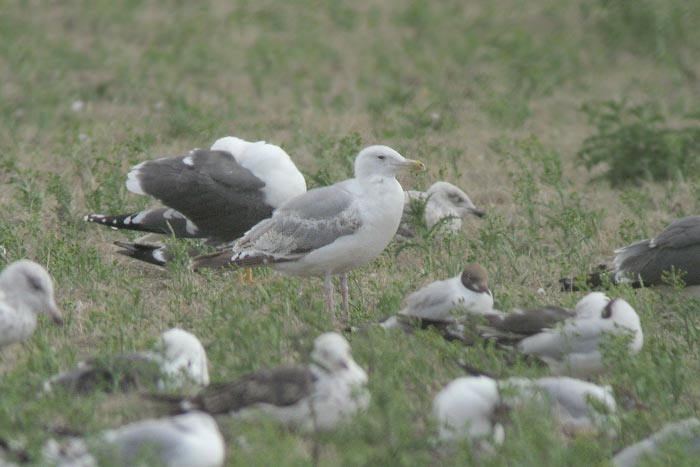
BLGP was quiet this evening; the showers did not produce much more than a Snipe and a Common Sand on the New Works.

Wednesday, 21 July 2010

More Gulls 21/7

I went gulling again today - it's about the only thing worth doing at the moment. In fact, it's probably the only thing worth doing in Peterborough at any time of year. Much improved on Monday, but that was presumably due to alot more gulls being present.

At Dogsthorpe Tip, I half-heartedly scanned the dump from the KFC car park and predictably saw nothing. However, I did get amongst the flock in the field south of KFC. Amongst the predominately Lesser Black-backed Gulls was this superb 2nd-summer Caspian Gull:


In addition to this beauty, there were at least six Yellow-legged Gulls in the same field. Who knows how many more were on the tip...


juvenile michahellis - these things are stunning when this fresh.

I moved on to Tanholt Pits, where a sizeable chunk of laridae was bathing/moulting/falling apart on the new pit. Amongst them was my first juvenile Mediterranean Gull of the year, as well as a couple more Yellow-leggeds (1st-summer and juvenile). Sadly my camera battery died halfway photographing the Casp, so no more pics!

I'll be back tomorrow.

Monday, 19 July 2010

Yellow-legged Gulls

Couple of juvenile Yellow-legged Gulls at Tanholt Pits this afternoon:


Bird one


Bird two

Also an eclipse drake Wigeon at BLGP today, but nothing else interesting. Been in Morocco recently; 16 WP ticks including Cricket Longtail, Pied Crow, White-faced Petrel and Black-crowned Finch Lark.